
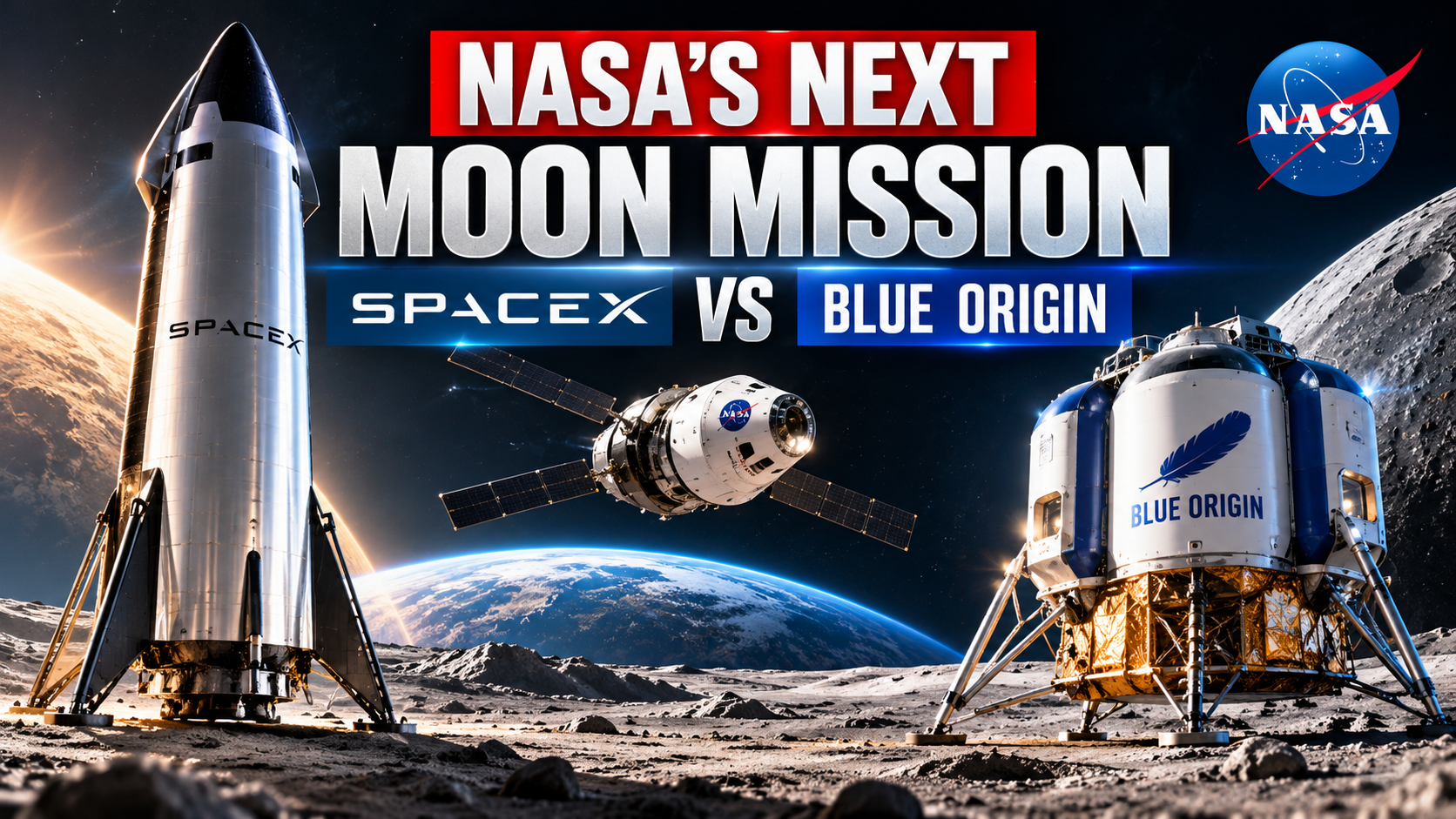
NASA is reshaping its next lunar mission into a critical test of two competing spacecraft. With SpaceX and Blue Origin preparing their lunar landers, the results could help determine how astronauts return to the Moon in 2028.
NASA’s next major step toward returning humans to the Moon will not involve astronauts landing on the lunar surface. Instead, the agency plans to send four astronauts into Earth orbit for an approximately 14-day mission designed to test the spacecraft and technologies needed for future lunar landings.
The mission, known as Artemis III, is scheduled for 2027. It will bring NASA’s Orion spacecraft together with test versions of lunar landers developed by SpaceX and Blue Origin, allowing engineers to evaluate how the different vehicles operate together in space.
The change reflects a broader effort to accelerate NASA’s lunar exploration programme. The agency is targeting Artemis IV for a crewed lunar landing in 2028, subject to spacecraft readiness and mission requirements.
The stakes extend beyond a single flight. Artemis III will help NASA assess two different approaches to lunar transportation, gather operational data and reduce risks before astronauts attempt to descend to the Moon’s surface.
According to NASA’s official Artemis III mission plan, the demonstration will involve multiple launches, complex orbital manoeuvres and docking operations that have never been attempted together in this configuration.
Why Artemis III Is No Longer a Lunar Landing Mission
The Artemis programme is NASA’s long-term effort to return astronauts to the Moon and establish the capabilities needed for sustained exploration.
Under the revised mission architecture, Artemis III will focus on testing critical systems in low Earth orbit rather than attempting a crewed lunar landing.
NASA plans to launch astronauts aboard its Space Launch System (SLS) rocket inside the Orion spacecraft. Once in orbit, the crew will conduct systems checks before carrying out rendezvous and docking demonstrations with commercial lunar lander test vehicles.
The mission will help engineers evaluate communications, navigation, flight-control systems, spacecraft interfaces and crew procedures.
Testing these systems close to Earth offers an important advantage. Engineers can gather operational experience and identify problems before attempting more complicated missions farther from the planet.
NASA is also changing how future lunar missions are expected to operate. Rather than relying on a single spacecraft to perform every stage of the journey, the programme combines NASA-developed systems with commercial vehicles that will transport astronauts between lunar orbit and the surface.
The revised approach creates a more flexible mission architecture, but it also introduces additional technical challenges. Different spacecraft must communicate, dock and operate together safely.
Artemis III is intended to help prove that those interactions can work as planned.
A Packed 14-Day Mission
NASA expects Artemis III to last approximately two weeks, although the final duration will depend on launch timing and how the orbital operations progress.
The mission will involve three separate spacecraft launched on different rockets within a carefully coordinated sequence.
1. Blue Origin launches first
The mission is expected to begin with Blue Origin launching a test version of its Blue Moon Mark 2 lunar lander into low Earth orbit.
The vehicle will wait in orbit while NASA prepares to launch Orion and its crew.
Once Orion reaches the appropriate orbit, the spacecraft will manoeuvre toward Blue Moon and attempt to rendezvous and dock.
This will provide NASA with an opportunity to evaluate how the Orion spacecraft interacts with a commercial lunar lander.
After docking, astronauts are expected to enter the Blue Moon test vehicle and spend approximately two days evaluating its systems.
These activities will include assessments of the cabin environment, controls, life-support functions and other technologies intended to support future crewed lunar missions.
The tests will also give flight controllers practical experience coordinating spacecraft developed by different organisations.
2. Orion meets SpaceX’s Starship
After completing the Blue Moon demonstration, Orion will undock and prepare for a second rendezvous operation.
SpaceX will launch a Starship test vehicle equipped with a docking system designed for the demonstration.
NASA and SpaceX plan to test the docking interface between Orion and Starship, evaluating spacecraft controllability, communications, software integration and the dynamics of connecting and separating the vehicles.
Unlike the Blue Moon demonstration, astronauts are not expected to enter the Starship test vehicle during this phase.
The two docking demonstrations will allow NASA to evaluate different spacecraft designs and operating procedures within a single mission.
Starship’s large size and its role in SpaceX’s broader lunar transportation architecture make it particularly important to the programme. However, the orbital demonstration will test specific capabilities; it will not, by itself, prove that the complete lunar landing system is ready for a crewed mission.
3. Additional tests before returning to Earth
Following the docking demonstrations, the crew will have additional time to complete experiments and spacecraft evaluations.
These activities are expected to include spacesuit assessments, docking sensor tests, thermal and acoustic measurements, human-factors studies and technology demonstrations.
NASA also plans to investigate how astronauts could conduct certain health assessments when direct communication with mission control is unavailable.
The crew will then prepare Orion for re-entry and splashdown in the Pacific Ocean, where recovery teams will retrieve the astronauts and spacecraft.
The overall objective is straightforward: learn as much as possible in Earth orbit before attempting a crewed lunar landing.
SpaceX vs Blue Origin: Two Different Routes to the Moon
The Artemis programme is also becoming an important test of commercial spaceflight.
SpaceX and Blue Origin are developing different spacecraft and mission architectures to transport astronauts from lunar orbit to the lunar surface and back.
Both companies are working toward the same broad objective, but their engineering approaches differ considerably.
SpaceX: Starship Human Landing System
<text color=”secondary” size=”sm”>Image suggestion: SpaceX Starship lunar lander concept.</text>
SpaceX is developing a lunar version of Starship, known as the Starship Human Landing System.
One of its defining features is its reliance on in-space propellant transfer. Rather than carrying all the fuel required for a lunar mission in a single launch, the architecture involves multiple Starship vehicles transporting propellant to a depot in low Earth orbit.
The lunar lander can then receive the propellant needed for its journey.
Under NASA’s revised concept, Starship will rendezvous with Orion in Earth orbit before carrying the combined spacecraft toward the Moon. The lander will eventually transport two astronauts to the lunar surface while the other two remain aboard Orion.
Following surface operations, the astronauts will return to Orion for the journey home.
The approach offers substantial payload potential, but it requires complex operations involving multiple launches, propellant transfer and spacecraft coordination.
NASA and SpaceX must demonstrate that these elements can work reliably before astronauts depend on the system.
Blue Origin: Blue Moon Mark 2
<text color=”secondary” size=”sm”>Image suggestion: Blue Origin Blue Moon lunar lander concept.</text>
Blue Origin is developing its Blue Moon Mark 2 lander as another option for NASA’s human lunar exploration programme.
Under the updated mission architecture, the company plans to use a series of transfer stages to move the lander toward the Moon.
These stages will launch into low Earth orbit and connect with the lander before departing toward an elliptical polar orbit around the Moon. As their propellant is depleted, the transfer stages will separate.
The architecture is designed to reduce the amount of propellant required by the lander itself and support the overall performance of the lunar mission.
Once the system reaches the appropriate lunar orbit, astronauts will transfer from Orion to Blue Moon and descend toward the lunar surface.
After completing their surface activities, they will return to Orion before travelling back to Earth.
Blue Origin’s approach avoids relying on the same in-space propellant-transfer architecture planned for Starship under the revised concept. However, it still requires multiple spacecraft, successful orbital operations and extensive testing.
NASA’s updated plans also call for an uncrewed demonstration of Blue Origin’s transfer-stage architecture before a crewed lunar mission.
Which Company Will Land Astronauts First?
For now, there is no definitive answer.
NASA has stated that the selection of a lunar lander for the 2028 crewed landing will depend on which system is ready to meet the agency’s safety and mission requirements.
Under the revised programme, neither SpaceX nor Blue Origin has been assigned an exclusive first landing mission.
That creates a competitive environment in which technical progress, testing results and operational readiness could determine which company gets the first opportunity.
The competition is not simply about which vehicle looks more advanced. NASA must establish that each system can transport astronauts safely, support their activities on the lunar surface and return them to lunar orbit.
Both companies must also complete uncrewed demonstrations before their landers can be certified for crewed lunar missions.
A successful Artemis III would provide valuable evidence, but it would not eliminate the need for further tests.
The final decision will depend on the full body of engineering and safety data collected throughout development.
Why NASA Is Accelerating Its Lunar Programme
NASA’s revised Artemis architecture reflects the difficulty of coordinating a complex human spaceflight programme with ambitious deadlines.
Returning astronauts to the Moon requires much more than a powerful rocket. The agency must integrate crew spacecraft, lunar landers, spacesuits, communications systems, mission-control operations and the infrastructure needed to support astronauts on the surface.
The commercial sector has become an increasingly important part of this effort.
By working with SpaceX and Blue Origin, NASA can pursue different technical approaches rather than depending entirely on one landing system.
That strategy can create flexibility and competition, although it also introduces integration challenges and dependencies on commercial development schedules.
The agency is targeting a 2028 crewed lunar landing through Artemis IV. The timeline remains dependent on technical progress, testing and the readiness of the required systems.
NASA’s longer-term ambition is to establish a more sustained human presence on the Moon, particularly around the lunar south pole, where future missions could investigate resources and support scientific research.
Artemis III is one step toward that objective, not the final destination.
What the Mission Means for the Future of Space Exploration
Artemis III could have implications well beyond NASA’s immediate lunar programme.
First, it will help establish whether spacecraft built by different commercial providers can operate together reliably during human spaceflight missions.
Second, it will provide data on technologies and procedures that could be adapted for more complex missions, including future journeys to Mars.
Third, it will demonstrate how governments and private companies can share responsibility for developing the systems needed for human exploration beyond Earth.
The commercial space industry is already expanding into launch services, satellite communications, lunar cargo delivery and other activities. Human lunar transportation represents another technically demanding market in which private companies could play a major role.
However, the commercial opportunities will depend on more than ambitious announcements. Flight performance, reliability, development costs and the ability to deliver on schedule will all matter.
For SpaceX and Blue Origin, Artemis III is an opportunity to demonstrate progress in front of one of the world’s most demanding customers.
For NASA, it is an opportunity to reduce the risks associated with returning astronauts to the Moon.
The Challenges NASA Still Needs to Overcome
Despite the revised plan, major challenges remain.
SpaceX must demonstrate its planned in-space propellant aggregation architecture and establish that its Starship lunar system can support crewed operations.
Blue Origin must demonstrate its transfer-stage architecture and verify the integrated performance of its lunar lander.
NASA must also ensure that Orion can rendezvous and dock with both systems, that the spacecraft can communicate effectively, and that crew operations can be conducted safely.
Mission scheduling adds another layer of complexity. The flight depends on multiple launches, orbital conditions, spacecraft readiness and successful execution of the planned demonstrations.
A delay in one part of the sequence could affect the broader mission timeline.
The 2028 lunar landing target is therefore an objective rather than a guarantee. The most important measure of success will be whether NASA can demonstrate the required capabilities safely, not simply whether the programme meets a particular date.
Conclusion: Artemis III Is About Proving the Technology
NASA’s Artemis III mission represents a significant change in how the agency plans to return humans to the lunar surface.
Instead of attempting a landing in 2027, the mission will focus on testing Orion’s ability to work with lunar lander systems developed by SpaceX and Blue Origin.
The approximately 14-day flight is expected to include two major docking demonstrations, evaluations of spacecraft systems and additional experiments designed to prepare astronauts for future missions.
The results could help NASA determine which lander is ready to support the next phase of lunar exploration.
For SpaceX and Blue Origin, the challenge is to turn ambitious spacecraft designs into reliable operational systems. For NASA, the priority is to ensure that every critical capability has been tested before astronauts attempt to land on the Moon again.
The lunar race is no longer only about reaching the Moon. It is about developing the technology, infrastructure and operational experience needed to return safely, explore more of the lunar surface and eventually support a sustained human presence beyond Earth.
The key question now is not simply who will build the lander. It is which system will prove ready to carry astronauts safely to the Moon and bring them home.
Sources and Further Reading
- NASA: Artemis III Mission to Test Future Moon Lander Operations
- NASA: Partners Accelerate Lander Development for 2028 Moon Missions
- NASA: Official Artemis III Mission Page
- Scientific American: NASA’s Artemis III Will Pit SpaceX Against Blue Origin
Editorial note: Mission dates and architecture can change as development progresses. This article reflects NASA’s published plans available as of October 27, 2026.
Disclaimer: This article is for informational and educational purposes. Mission targets are subject to change and should not be interpreted as guarantees of launch or landing dates.
Discover more from Pasindu Lakshan Perera
Subscribe to get the latest posts sent to your email.

Related Posts

Analyzing the Exponential Rise of the Indian Space Ecosystem

Navigating the Strategic Challenges of NASA’s Nuclear Future