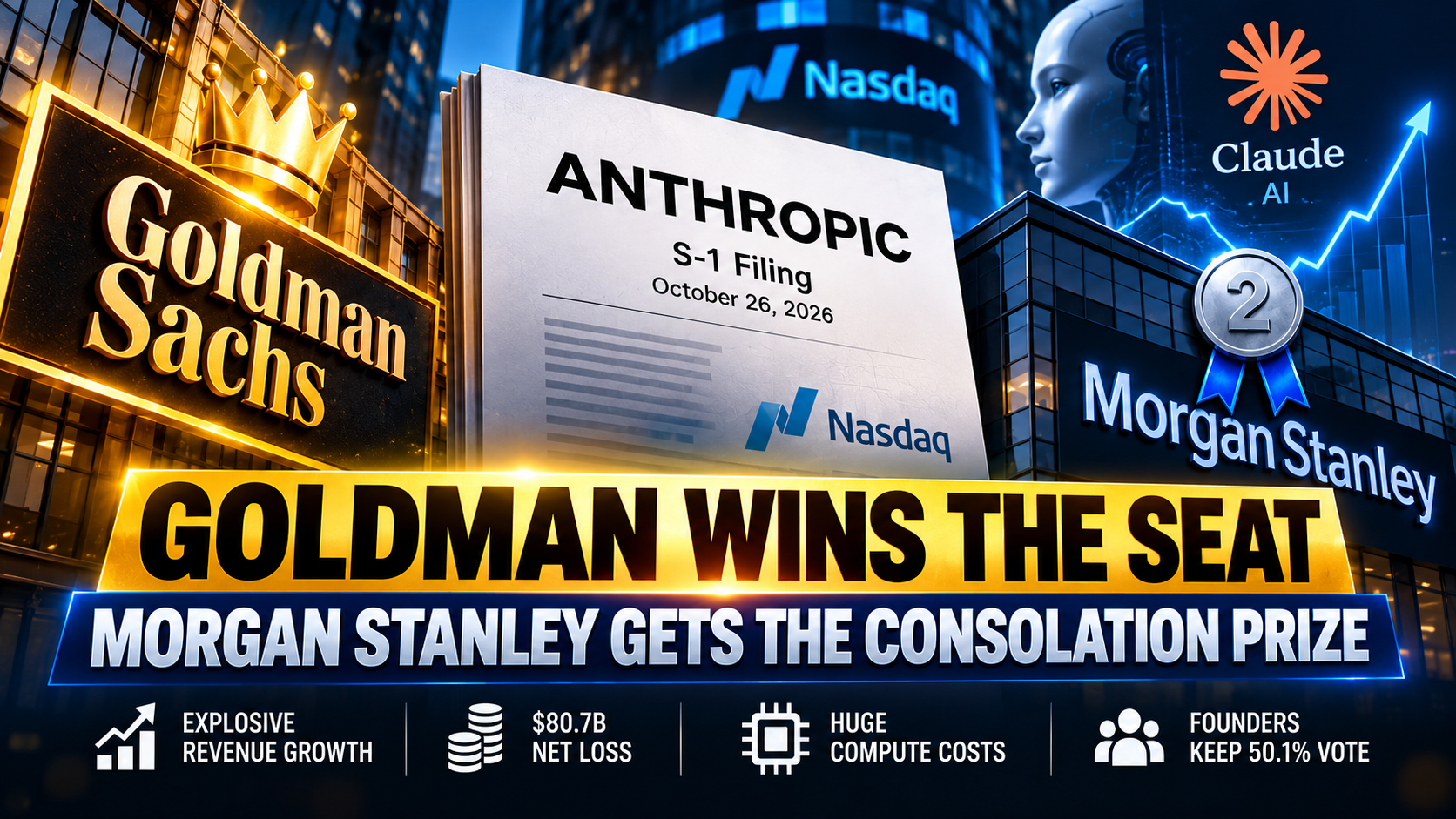
Anthropic’s October 26 filing reveals explosive revenue growth, a staggering accounting loss and a high-stakes test for AI valuations.
Wall Street finally has an answer to one of its biggest IPO questions of the year: Goldman Sachs will lead Anthropic’s planned public offering, with Morgan Stanley serving as a fellow lead underwriter and stabilization agent.
The decision, disclosed in Anthropic’s October 26, 2026, registration statement, gives Goldman the coveted “lead-left” position in what could become one of the most closely watched technology listings in recent history. It also puts the two investment banks back in prominent roles following their involvement in SpaceX’s June IPO.
But the bank rivalry is only part of the story. Anthropic’s first public financial disclosures reveal a business growing at extraordinary speed, a huge accounting-driven loss and an expensive race to secure the computing infrastructure needed to compete in AI.
The question investors will eventually have to answer is whether that growth can justify the price the market is willing to pay.
Why Goldman’s position matters
In an IPO, the lead-left underwriter is typically the bank listed first on the prospectus. The role is more than a matter of prestige: it can bring significant influence over the offering process, investor relationships and share allocation.
That influence matters because IPO shares are often in high demand. Institutional investors want access to attractive new listings, and the banks managing those offerings control an important part of the distribution process.
Goldman’s appointment therefore represents a strategic win. Morgan Stanley remains an important participant, but its role as stabilization agent is distinct from Goldman’s lead-left position. Stabilization involves managing the early trading process within the applicable regulatory framework; it does not mean Morgan Stanley has lost all influence over the deal.
The distinction is particularly relevant given the scale of recent mega-IPOs. Reporting by Fortune on SpaceX’s offering highlighted how the lead-left bank can benefit from its role in distributing shares, beyond the underwriting fee alone.
The potential economics, however, should not be confused with guaranteed profits. Investor demand, the final offering terms and actual trading performance will determine how valuable the mandate ultimately becomes.
The IPO syndicate is bigger than two banks
Goldman Sachs and Morgan Stanley are not working alone. Anthropic’s filing names a syndicate of 22 underwriting banks, including JPMorgan, Citigroup, Barclays, Wells Fargo and Bank of America.
That broad lineup reflects the complexity of taking a company of Anthropic’s scale to public markets. Large offerings require extensive institutional distribution, investor coordination and execution capabilities.
The deal also gives the participating banks an opportunity to strengthen their positions in the global IPO market. For Goldman, the lead-left appointment is a particularly prominent win. For Morgan Stanley, the assignment still provides a substantial role in a potentially landmark transaction.
And the competition may not end here. With OpenAI also widely discussed as a potential future IPO candidate, the battle for major AI listings could remain a significant contest among Wall Street’s investment banks.
Anthropic’s revenue growth is extraordinary
The financial disclosures are arguably more important than the underwriting lineup.
Anthropic, the company behind Claude, reported revenue of approximately $16.3 billion for the six months ended June 30, 2026, compared with approximately $1.16 billion in the same period of 2025.
That represents roughly 14 times the previous year’s revenue, or growth of around 1,300%.
The company’s second-quarter performance was particularly striking, with revenue increasing by 1,368% year over year, according to Reuters.
These figures show how rapidly demand for advanced AI services has expanded. Anthropic has built a substantial enterprise business, with more than half of Fortune 500 companies among its customers that generated at least $100,000 in revenue for the company over the 12 months ended September 30.
For investors, that customer base matters. Enterprise adoption can create recurring demand and deeper commercial relationships, although it does not automatically guarantee that revenue growth or profitability will continue at the same pace.
The $80.7 billion loss needs context
Anthropic’s headline net loss for the first half of 2026 was approximately $80.7 billion.
At first glance, that figure appears difficult to reconcile with its rapidly growing revenue. But the composition of the loss is crucial.
Approximately $72.4 billion was associated with changes in the fair value of convertible notes, derivative liabilities and simple agreements for future equity, or SAFEs. These instruments can generate substantial accounting expenses when a company’s valuation rises and the value of its conversion-related obligations changes.
That does not make the loss irrelevant. It does mean investors should distinguish between the reported net loss and the underlying performance of the operating business.
Anthropic’s operating loss was approximately $693 million for the first half of 2026, down from roughly $2.14 billion in the comparable period of 2025. The company also reported adjusted operating income of approximately $1.62 billion for the first half.
Those measures paint a different picture from the headline net loss, but neither should be interpreted in isolation. Adjusted operating income is a non-GAAP measure, and operating performance does not capture every financing cost, capital commitment or future cash requirement.
The takeaway is not that Anthropic has no financial problems. It is that understanding those problems requires looking beyond a single number.
Compute is becoming a defining financial risk
Building advanced AI models requires enormous amounts of computing capacity, and Anthropic’s disclosures underline the scale of that commitment.
The company reported that computing and infrastructure expenses rose to approximately $8.95 billion from $2.33 billion in the comparable first-half period of 2025.
It has also committed more than $600 billion to computing arrangements with partners including Amazon and Google, according to Reuters.
These commitments highlight a central tension in the AI business model. More computing power can support better products, greater usage and higher revenue. At the same time, infrastructure requirements create substantial costs and dependencies on a relatively small number of suppliers.
Anthropic expects computing and infrastructure to remain its largest operating expense.
For prospective shareholders, the important question is whether revenue growth, product pricing and operating efficiencies can eventually outpace the cost of developing and delivering increasingly capable AI systems.
That is a much harder question than simply deciding whether demand for Claude is growing.
Who will control Anthropic after the IPO?
The filing also describes a governance structure that deserves attention.
Anthropic’s seven co-founders, through the Founder LLC, are set to retain 50.1% of voting power through a single Class F share. The company’s Long-Term Benefit Trust also has significant influence over board composition.
This structure is designed to preserve the company’s governance priorities, but it has implications for public investors.
Buying shares does not necessarily mean obtaining voting influence proportional to the economic stake acquired. Investors will need to assess not only the company’s growth prospects but also how its governance arrangements affect accountability and shareholder rights.
For a company that has positioned AI safety and responsible development as central priorities, governance is particularly relevant.
What valuation should investors expect?
This is where the uncertainty becomes most important.
Anthropic has applied to list its Class A common stock on the Nasdaq Global Select Market under the ticker ANT. However, the October 26 filing does not yet specify the final share count or IPO price range.
Reports have placed potential investor valuations around $1.5 trillion to $2 trillion, but those figures are expectations and reported estimates, not an official IPO valuation.
Investors should also distinguish valuation from the amount of money the company intends to raise. A company’s market capitalization, the proceeds from newly issued shares and the value of shares sold by existing shareholders are different measures.
Until Anthropic discloses the offering terms, any precise estimate of its eventual market capitalization remains speculative.
The eventual pricing will depend on investor demand, the company’s financial outlook, market conditions and how investors weigh its growth against the substantial costs and risks of operating an advanced AI business.
The bigger test for the AI market
Anthropic’s IPO arrives at a time when investors are reassessing the economics of the AI boom.
The technology offers the possibility of significant productivity gains and new commercial opportunities. But building the infrastructure and models required to deliver those benefits demands enormous investment, and the returns remain uncertain.
Anthropic’s prospectus also highlights risks involving AI misuse, cybersecurity, model behaviour and reliance on major infrastructure providers.
These are not merely theoretical concerns. They can affect the company’s costs, regulatory exposure, reputation and ability to deliver products reliably.
The listing could therefore become a useful benchmark for how public-market investors value leading AI companies. A strong reception would signal continued willingness to finance the sector at ambitious valuations. A disappointing one could prompt investors to scrutinize the relationship between AI spending, revenue growth and sustainable returns more closely.
My take
Goldman Sachs has secured the lead-left seat, but the more consequential question is what happens when Anthropic’s financial performance is judged in the public markets.
Revenue growth is extraordinary. Operating performance has improved significantly. Yet computing costs, financing-related accounting volatility, governance arrangements and long-term infrastructure commitments all deserve careful scrutiny.
The $80.7 billion net loss makes a dramatic headline, but it is not, by itself, a complete measure of the business. Equally, rapid revenue growth does not automatically justify a trillion-dollar valuation.
For investors, the most useful next milestone will be the final IPO price range and offering structure. Those details will provide a firmer basis for evaluating the company’s implied valuation and the risks attached to it.
Goldman may have won the seat. Whether investors will accept the price is a different question entirely.
Disclosure: Claude is developed by Anthropic. This article discusses Anthropic’s business and proposed IPO; readers should consider that relationship when evaluating the analysis.
Disclaimer: This article is for informational and educational purposes only. It is not investment advice or a recommendation to buy or sell any security.
Sources: Anthropic’s official IPO announcement, its October 26, 2026 SEC S-1 filing, Reuters’ coverage of the filing and Fortune’s analysis of the economics of SpaceX’s IPO.
Reporting cutoff: October 27, 2026. IPO terms and market expectations may change as additional information becomes available.
Discover more from Pasindu Lakshan Perera
Subscribe to get the latest posts sent to your email.

Related Posts
The “Ant” Exodus: Deconstructing South Korea’s Retail Investment Crisis and the Macroeconomic Fallout

Torpedoes: The Silent Architects of Underwater Dominance