
Just as services like FedEx and DHL transformed global commerce by creating a reliable network for moving goods anywhere on Earth, a new generation of companies is building the logistics infrastructure for the final frontier. As access to space becomes more routine, the industry’s focus is shifting from simply reaching orbit to creating a sophisticated, point-to-point delivery network that spans from low-Earth orbit to the Moon. This burgeoning field of space logistics is no longer a niche concept; it is a strategic and rapidly expanding market. Valued at USD 1.5 billion in 2024, the sector is projected to surge to over USD 17.76 billion by 2030, growing at a compound annual growth rate (CAGR) of between 17.3% and 19.08%. This blog post will explore the critical technologies, powerful market drivers, and significant challenges shaping the new era of orbital courier services.
1. The New Space-Age Supply Chain: Redefining “Delivery”
The space industry is undergoing a fundamental strategic shift, moving beyond a launch-centric model to a full-service logistics ecosystem. A “space courier” does far more than just ferry a payload to orbit. The new definition of delivery encompasses precision orbital placement, a growing portfolio of in-orbit services, and the game-changing capability to return cargo and manufactured products safely back to Earth.
1.1. Last-Mile Delivery
In the space economy, the concept of “last-mile delivery” has become critical. Large rockets, especially on popular rideshare missions, function like long-haul freight, deploying numerous satellites into a general orbital region. This is where Orbital Transfer Vehicles (OTVs), often called “space tugs,” play a vital role. These agile vehicles act as the final-leg delivery vans, maneuvering individual payloads from the rocket’s drop-off point to their precise, final operational orbits. This service is not just a convenience; it is an essential enabling technology for the efficient deployment of large and complex satellite constellations.
1.2. In-Orbit Services
Beyond simple deployment, today’s space courier platforms offer an expanding suite of in-orbit services that extend the life and value of space assets. These services are transforming the economics of satellite operations and creating entirely new business models.
- Life Extension: Specialized vehicles can dock with aging but otherwise functional satellites to provide propulsion and station-keeping. Northrop Grumman’s Mission Extension Vehicle (MEV), for example, successfully docked with an Intelsat satellite, effectively acting as a jetpack to extend its operational life by several years.
- Refueling: The ability to refuel satellites in orbit promises to dramatically extend mission duty cycles. Companies like Orbit Fab are developing the architecture for in-space “gas stations,” a capability that could double the useful life of expensive spacecraft and fundamentally alter replacement economics.
- Debris Removal: As low-Earth orbit becomes increasingly congested, active debris removal is transitioning from a theoretical need to a commercial imperative. This segment is projected to grow at an impressive 22.45% CAGR through 2030, driven by new regulatory mandates and rising liability concerns over potential collisions. This transforms debris from an externality into a direct operational cost, creating a viable, non-speculative market for cleanup services. Companies like Astroscale are pioneering services to capture and de-orbit space junk, ensuring the long-term sustainability of the orbital environment.
1.3. Earth Return and Point-to-Point Transport
Perhaps the most revolutionary new capability is “downmass”—the ability to return cargo from space to Earth. This technology unlocks two transformative use cases that promise to redefine both orbital industry and terrestrial logistics.
- In-Space Manufacturing: Companies are developing miniature orbital factories to produce materials—like exotic crystals or pharmaceuticals—that benefit from a zero-gravity environment. Varda’s successful return of manufactured crystals demonstrated the viability of this model, proving that reentry vehicles can serve as the crucial return link for a new orbital manufacturing economy.
- Rapid Terrestrial Logistics: The Department of Defense is actively pursuing its Rocket Cargo program, which envisions using space transport as the ultimate high-speed delivery service. The program’s goal is to leverage commercial rockets to deliver up to 100 tons of critical cargo anywhere on Earth in under 90 minutes, a capability once relegated to science fiction that could revolutionize military and humanitarian logistics.
Together, these two capabilities represent the bookends of a new in-space industrial loop—one that can manufacture goods in orbit for niche terrestrial markets and another that can bypass traditional global supply chains for high-stakes government logistics. These diverse services are made possible by an innovative new generation of space hardware.
2. The Workhorses of the Final Frontier: Enabling Technologies
The space logistics revolution is built on a foundation of innovative and increasingly reusable hardware. These systems are the “trucks,” “delivery vans,” and “return vehicles” of the burgeoning space economy, each playing a distinct but interconnected role in the new orbital supply chain.
2.1. The “Trucks”: Reusable Rockets and Rideshares
The economic viability of space logistics rests squarely on the shoulders of reusable launch vehicles. By perfecting rocket reusability, SpaceX has fundamentally altered the cost equation for reaching orbit, driving per-mission prices down from approximately USD 62 million to roughly USD 15 million. This dramatic cost reduction has made frequent rideshare missions—where multiple small satellites are launched on a single rocket—a practical and popular reality, effectively creating the “long-haul freight” service of the space industry.
2.2. The “Delivery Vans”: Orbital Transfer Vehicles (OTVs)
Once the rideshare rocket reaches its general destination, OTVs take over for the crucial last mile. These space tugs are the precision delivery system of the orbital environment, capable of maneuvering customer satellites to specific altitudes, inclinations, and orbital planes. A growing number of commercial providers now offer diverse OTV platforms, each with unique capabilities.
| Company/Provider | Platform/Vehicle | Key Function/Feature |
| D-Orbit | ION Satellite Carrier | Has a flight-proven record of deploying small satellites for customers like Planet Labs. |
| Rocket Lab | Photon | An evolution of the Electron kick stage, capable of lunar and interplanetary missions, as proven with the NASA CAPSTONE mission. |
| Impulse Space | Mira | A proven OTV capable of providing 600 m/s of delta-v for a 300 kg payload for orbital transport and constellation deployment. |
| Momentus | Vigoride | Uses water plasma engines (MET) to perform orbital adjustments for payloads up to 800 kg. |
| Firefly Aerospace | Elytra | A line of orbital vehicles building upon SHERPA heritage, designed for missions from LEO to lunar orbits. |
The diversity of OTVs, from Rocket Lab’s interplanetary-capable Photon to Momentus’s high-efficiency water-plasma Vigoride, illustrates a market that is not converging on a single solution but is instead specializing to serve distinct orbital regimes and customer needs.
2.3. The Crucial Return Leg: Reentry Vehicles
Mastering atmospheric reentry is the final piece of the logistics puzzle, enabling both orbital drop and point-to-point delivery. This is one of the most technically demanding challenges in aerospace, and several companies are developing innovative vehicles to bring cargo back to Earth with precision and reliability.
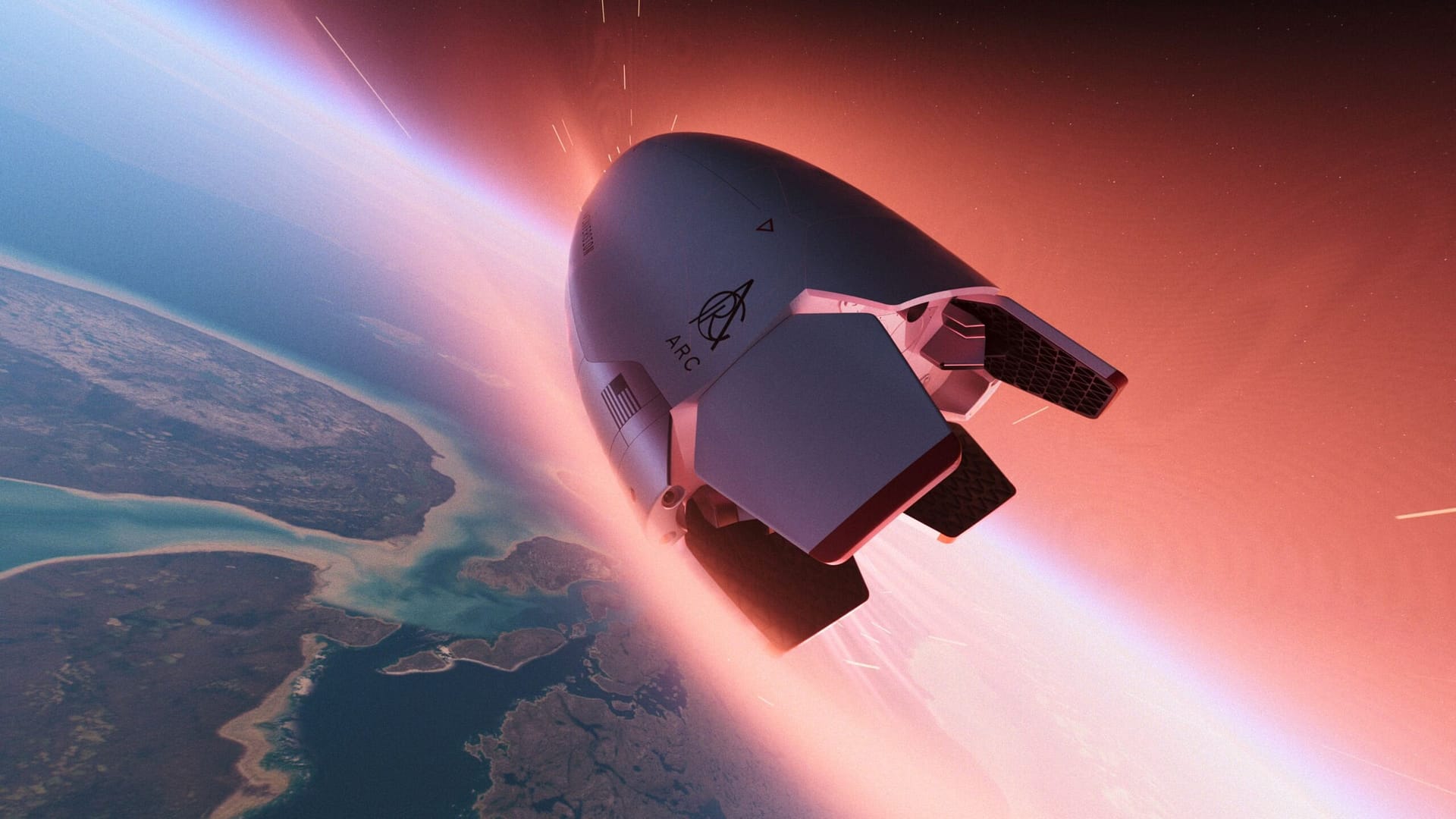
- Inversion Space: Is developing the Arc vehicle, an orbital spacecraft designed for under-60-minute global delivery with a target accuracy of just 6 meters.
- Outpost: Is building its Ferryall and Carryall vehicles, which use a unique deployable fabric heat shield and a robotically controlled paraglider for a pinpoint landing.
- Sierra Space: Is developing the Ghost reentry system, designed to deliver up to 150 kg of critical equipment to any location on Earth within 90 minutes.
- SpaceX: With Starship, the company is developing the ultimate fully reusable system for point-to-point transport and has a contract to demonstrate its ability to land 30 metric tons of government cargo.
The competing approaches are notable: while Inversion and SpaceX pursue hardened capsules reminiscent of traditional designs, Outpost is pioneering a more novel architecture with its deployable fabric heat shield and guided parafoil, betting on mass efficiency and landing precision over heritage. This powerful new hardware is being developed in response to a surge in demand from a wide range of customers.
3. A Booming Market: Who Needs a Package Delivered in Space?
Demand for sophisticated space logistics is surging from a diverse customer base spanning the commercial, government, and defense sectors. Each of these segments has unique and compelling needs that are collectively fueling market growth, technological innovation, and intense competition.
3.1. The Commercial Constellation Gold Rush
The deployment of massive small-satellite constellations for global internet and Earth observation is a primary market driver. Projects like SpaceX’s Starlink, OneWeb, which has filed for a constellation of over 6,300 satellites, and Amazon’s Project Kuiper, which targets over 3,000 spacecraft, represent an unprecedented industrial scale-up in orbit. These vast networks require precise orbital insertion for thousands of satellites, ongoing maintenance, and regular replacement missions, creating a continuous and high-volume demand for deployment and logistics services. This “gold rush” is the primary business case for the OTVs detailed earlier; deploying thousands of satellites into precise, phased orbital slots is an intractable problem for launch vehicles alone, making last-mile delivery an essential, non-negotiable service.
3.2. Government Science and Exploration
Government agencies, particularly NASA, continue to be anchor tenants for the space logistics industry. Their long-term programs provide a stable foundation of demand that enables commercial companies to mature their services.
- Servicing the International Space Station (ISS): NASA’s Commercial Resupply Services (CRS) program is a foundational example of a government-funded courier service. For years, vehicles like Northrop Grumman’s Cygnus and SpaceX’s Dragon have delivered cargo to the ISS. Critically, the Dragon capsule also provides “downmass” capability, returning valuable scientific experiments and hardware to Earth.
- Enabling the Lunar Economy: As it plans for a sustained presence on the Moon, NASA has identified a significant “demand gap opportunity” for commercial landers capable of delivering mid-size cargo—ranging from 500 kg to 12,000 kg—to the lunar surface. This is a clear market signal to both U.S. industry and international partners, encouraging the development of a new class of lunar cargo services to support future habitats, rovers, and scientific instruments. This market signal is not just about capacity; drawing lessons from the International Space Station, NASA is strategically fostering a diverse marketplace to ensure dissimilar redundancy, preventing a single point of failure in the critical lunar supply chain.
3.3. Defense and Strategic Delivery
The military sector has its own unique and urgent requirements for space logistics. The Department of Defense (DoD) sees immense strategic value in the ability to deliver supplies and equipment from orbit. This capability is particularly critical for resupplying forces in contested or anti-access zones, where traditional cargo aircraft like the C-17 would be at high risk. The U.S. Air Force’s Rocket Cargo program, along with significant STRATFI contract awards to companies like Inversion Space, Outpost, and Varda, demonstrates the Pentagon’s serious investment in making rapid, space-based delivery a battlefield reality.
While these market opportunities are driving the industry forward, operators face significant operational and financial risks.
4. Navigating the Hazards: The Risks of the Space Courier Business
While the opportunities in space logistics are vast, the path to profitability is fraught with peril. Operators must contend with a hazardous physical environment in orbit and navigate a complex, high-stakes legal and financial landscape on the ground.
4.1. The Traffic Jam Above: The Threat of Orbital Debris
The growing problem of orbital debris poses a constant and tangible threat to all space operations. The sheer volume of junk is staggering, and its high velocity makes even tiny fragments dangerous.
- Volume: There are an estimated ~23,000 trackable objects softball-sized or larger, ~500,000 marble-sized objects, and over >100,000,000 dot-sized objects currently in orbit.
- Risk: At orbital velocities approaching ~10 km/sec, a collision with even sub-millimeter debris poses a realistic threat to a spacecraft’s survival. The destructive potential of larger debris was starkly demonstrated by the 2009 collision that destroyed the operational Iridium 33 satellite. Consequently, collision avoidance maneuvers are a constant operational necessity for satellite and OTV operators.
4.2. The High Cost of Failure: Liability and Insurance
The legal framework governing space activities places an enormous burden of responsibility on operators. Under foundational international agreements like the Outer Space Treaty, the “launching State” is held absolutely liable for any damage caused on Earth or to another country’s spacecraft by one of its space objects.
This national-level liability is passed down directly to private operators through domestic laws, which typically mandate massive insurance coverage. In the United States, for example, a company may be required to secure up to $500 million in third-party liability insurance for a single launch. This creates an extremely complex and expensive insurance market, making coverage a significant operational cost. For startups, this regulatory burden is a formidable barrier to entry, making access to capital and affordable insurance as critical as the technology itself.
Despite these challenges, the industry continues to push forward, laying the groundwork for a new economic frontier.
5. Conclusion: The Dawn of a True Space Economy
The space industry is in the midst of a profound transformation, evolving from a singular focus on launch to the construction of a comprehensive, multi-layered logistics network. Spurred by the economic efficiencies of reusable rockets and the insatiable demand from massive new satellite constellations, a new sector of orbital couriers has emerged. These companies are pioneering critical services like last-mile delivery, in-orbit servicing, and Earth-return capabilities that were once the stuff of science fiction. As these courier services mature, they will become more than just a support industry; they will form the essential backbone of a true, self-sustaining space economy. Ultimately, the success of these orbital couriers will not be measured in orbits achieved, but in the economic value they unlock, transforming space from a destination into a dynamic, integrated component of the global economy.
Discover more from Pasindu Lakshan Perera
Subscribe to get the latest posts sent to your email.

Related Posts

An Architectural Blueprint for Future Orbital Disaster Response

Inside the First AI-Planned Drive on Mars
