
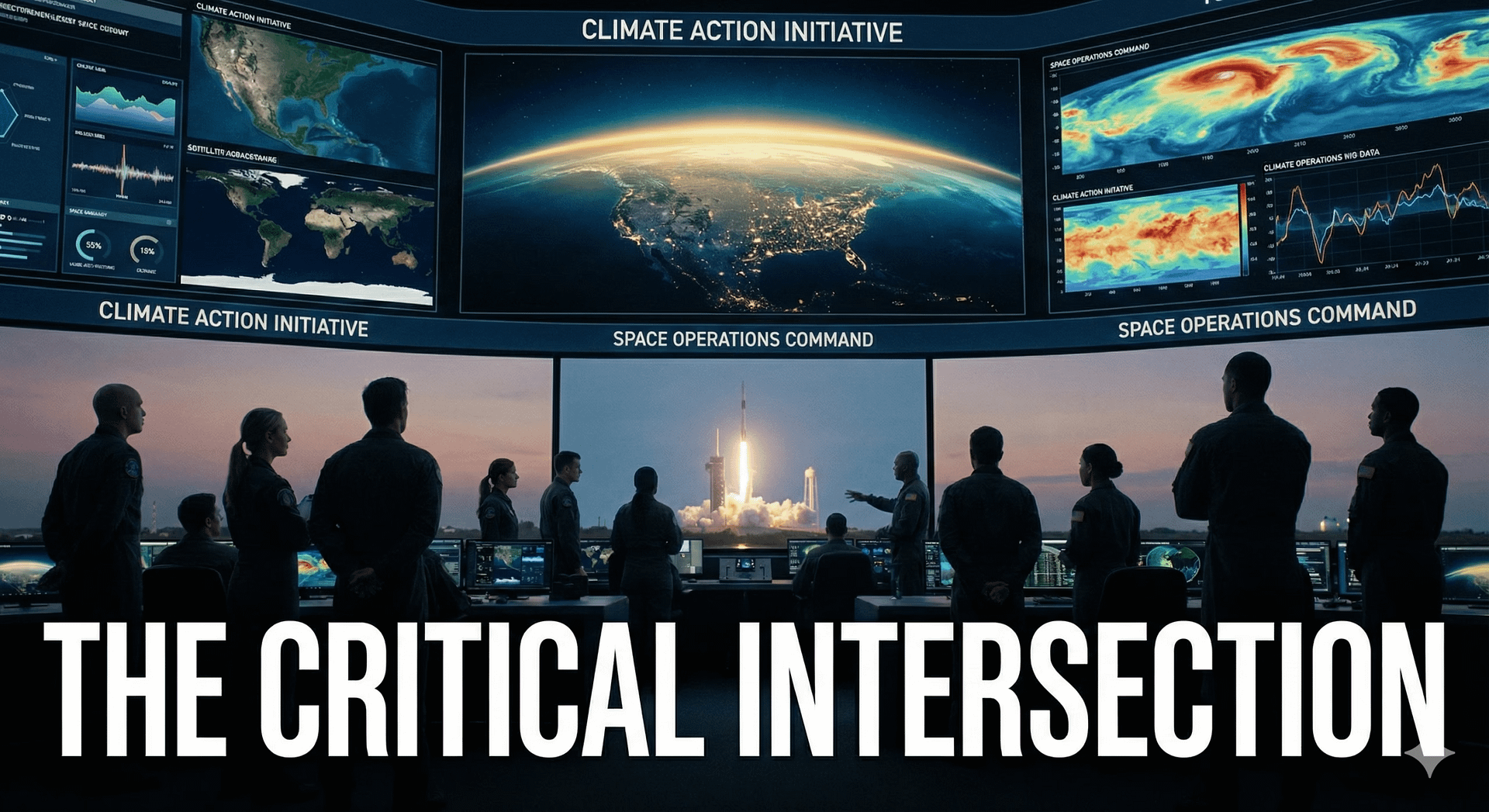
From orbit, we gain a unique and unparalleled perspective on the health of our planet. This celestial vantage point has become indispensable in the global fight against climate change, providing the objective, large-scale data necessary to understand and address this Earthly crisis. In fact, space-derived information now forms the very backbone of climate science, guiding policy, validating models, and tracking the progress of international commitments. Yet, this is not a one-way relationship. The space sector is both a critical observer of climate change and increasingly vulnerable to its impacts, all while confronting its own environmental footprint. This analysis explores the three core intersections of this operational dependency, framing them as a single strategic imperative for the global space community. A failure in any one domain be it in-orbit monitoring, terrestrial infrastructure resilience, or in space sustainability creates a systemic risk that critically undermines global climate action.
1. The View from Above: Space as the Ultimate Climate Watchtower
The strategic importance of space-based observation for understanding and confronting climate change cannot be overstated. From monitoring greenhouse gas concentrations to tracking sea-level rise and ice melt, satellites provide the comprehensive, consistent, and global data that underpins our climate knowledge. Multilateral frameworks like the Paris Agreement are fundamentally dependent on this technology; space based monitoring is the primary mechanism for verifying the national commitments, known as Nationally Determined Contributions (NDCs), that form the cornerstone of the treaty. Effectively leveraging these assets requires a deeply collaborative international environment, where space-based systems serve as the eyes in the sky that allow nations to measure progress, refine strategies, and ensure mission assurance for global climate goals.
The Foundational Role of Space Technology
Space-derived information is fundamental to nearly every aspect of climate action, from high-level policy development to on-the-ground resilience projects. It empowers scientists, informs governments, and enables a coordinated global response. Space infrastructure provides essential support across four primary categories of climate action:
- Climate Change Mitigation: Supporting efforts to reduce greenhouse gas emissions by monitoring sources, tracking deforestation, and verifying the effectiveness of mitigation strategies.
- Adaptation: Providing crucial data for adjusting to the present and future effects of climate change, such as mapping flood risks and monitoring agricultural conditions to enhance food security.
- Resilience: Strengthening the capacity of communities to cope with and recover from climate-related hazards by enabling early warning systems and supporting disaster risk reduction.
- Monitoring: Measuring and reporting on progress toward national and global climate goals, ensuring transparency and accountability under international agreements.
The Global Collaborative Ecosystem
No single nation can provide the full spectrum of observations required for comprehensive climate monitoring. This necessity has fostered a robust ecosystem of international cooperation, coordinated through key intergovernmental bodies. These organizations work to harmonize satellite missions, share data, and ensure that space-based assets serve the global community’s needs.
| Key Intergovernmental Body | Core Climate Mission |
| Committee on Earth Observation Satellites (CEOS) | Serves as the primary forum for international coordination of civil space based Earth observation programs. |
| Coordination Group for Meteorological Satellites (CGMS) | Globally coordinates meteorological satellite systems to support operational weather forecasting and climate monitoring. |
| World Meteorological Organization (WMO) | Provides the framework for international cooperation in meteorology, climatology, and operational hydrology. |
| United Nations Framework Convention on Climate Change (UNFCCC) | Functions as the parent treaty of the Paris Agreement and the primary international forum for negotiating the global response to climate change. |
This intricate web of collaboration means that a data gap from one agency’s satellite doesn’t just affect that agency; it degrades the quality of the global climate record, impacting UNFCCC stocktakes and national adaptation policies worldwide. Yet, this vital celestial watchtower is supported by terrestrial infrastructure that is itself in the direct path of the climate hazards being monitored, creating a profound operational paradox.
2. The View from the Ground: Climate Change at the Doorstep of Space Operations
While satellites watch over the Earth, the ground-based infrastructure that supports them is increasingly vulnerable to the very changes being observed. NASA, a world leader in climate science, is a prime example of this paradox; two-thirds of the agency’s assets are located within 16 feet of sea level. This stark reality creates a strategic dependency on terrestrial climate adaptation to ensure mission assurance for critical space-based assets. A catastrophic failure at a coastal launch site isn’t just an infrastructure loss; it’s a direct threat to launching the next generation of satellites that CEOS, WMO, and others rely on for their climate mission.
Direct Climate Risks to Space Facilities
NASA’s Wallops Flight Facility (WFF), located on Virginia’s Eastern Shore, serves as a compelling case study of the climate-related threats facing coastal space infrastructure. Its location and operational history expose it to a combination of hazards that are being amplified by climate change.
- Coastal Flooding and Storm Surge: Situated directly on the coast, WFF is highly susceptible to inundation from storm surges and increasingly frequent high-tide flooding events.
- Shoreline Erosion: The facility has a long history of battling shoreline retreat, requiring costly beach replenishment projects and contending with the failure of past groin systems designed to hold back the sea.
- Increased Hurricane Activity: Climate models project an increase in the frequency and intensity of hurricanes impacting the facility, threatening key launch and support structures.
- Projected Climate Shifts: Research by the Climate Adaptation Science Investigators (CASI) projects inevitable increases in annual temperature, total precipitation, sea level rise, and extreme events like heatwaves for the region, compounding all other vulnerabilities.
Innovative Adaptation Strategies
These vulnerabilities demand new and innovative approaches to facility design and construction. One potential adaptation strategy is the use of Intermodal Steel Building Units (ISBUs)—more commonly known as shipping containers as a primary construction material. These units offer a unique combination of resilience and flexibility, though they are not without their challenges.
| Advantages | Disadvantages |
| Durability: ISBUs are designed to withstand harsh winds and storms at sea, making them inherently robust. | Insulation Challenges: Steel is an excellent conductor of heat, requiring significant insulation which can reduce interior space. |
| Cost-Effectiveness: Repurposed containers can be significantly cheaper than conventional structures. | Potential Toxic Concerns: Paints and treated timber floors may require sandblasting and sealing. |
| Speed of Construction: Buildings can be prefabricated off-site for rapid assembly. | Refurbishing Needs: Used containers often have rust and dents that must be properly refurbished. |
| Eco-friendliness: Upcycling a single 40-foot container reuses approximately 3,500 kg of steel. |
Securing terrestrial assets against climate change is a resource-intensive necessity; this economic pressure, combined with the growing orbital congestion, makes pioneering a sustainable and efficient in-space logistics paradigm not just an environmental goal, but a fiscal and operational imperative.
3. A Sustainable Frontier: Greening Our Approach to Space Operations
The space sector is undergoing a profound transformation. This “new logistics paradigm in space” is defined by breakthroughs like reusable rocketry, the proliferation of nanosatellites, and the deployment of massive satellite constellations. While this rapid expansion creates unprecedented opportunities, it also amplifies critical sustainability challenges, most notably the growing threat of space debris. To ensure that humanity can continue to benefit from space for generations to come, it is essential to develop a long term, sustainable vision for the entire space ecosystem.
Core Tenets of Sustainable Space Logistics (SSL)
The Research Initiative on Sustainable Space Logistics (RISSL) at EPFL is at the forefront of this effort, organizing research at macro, meso, and micro scales to address the key challenges and opportunities in making space operations more sustainable. This work highlights several crucial areas of focus:
- Active Debris Removal (ADR): The accumulation of orbital debris, especially in valuable Low Earth Orbits (LEO), poses a significant risk to current and future missions. This is not just an environmental issue but a burgeoning commercial market driven by the need to protect billions of dollars in satellite constellation investments, spurring interest in ADR services to deorbit failed satellites and mitigate collision risks.
- On-Orbit Servicing: The new logistics approach opens the door for on-orbit servicing, manufacturing, and assembly, which can extend the life of satellites, reduce the need for replacement launches, and create a more circular space economy.
- Green Space Logistics (GSL): This concept aims to minimize the environmental impact of the entire lifecycle of space assets, from manufacturing on the ground to launch operations. This includes assessing the environmental effects of different propellant types and analyzing the impact of complex supply chains.
The Role of Advanced Modeling Tools
Developing sustainable and efficient space missions requires sophisticated planning tools that can analyze complex trade-offs. The Technology Combination Analysis Tool (TCAT), developed at EPFL, is one such software designed to model and optimize space logistics scenarios. Its purpose is twofold:
- To offer quick feasibility assessments of space missions, allowing engineers and planners to rapidly evaluate different concepts.
- To enable trade-offs between different mission architectures by providing rough estimates of key performance indicators like cost and mass.
TCAT is a versatile tool capable of modeling a range of modern use cases, including LEO logistics, missions to the Moon, complex active debris removal campaigns, and the deployment of satellite constellations. Tools like TCAT are therefore central to the concept of Green Space Logistics, as they allow for the optimization of mission architectures to minimize launch mass, propellant consumption, and potential debris generating maneuvers before costly hardware is ever built.
This integrated approach, linking high-level observation with ground-level adaptation and in orbit sustainability, forms the foundation of a unified global effort for both space and climate.
4. Conclusion: A Unified Vision for Space and Climate
The intricate relationship between space operations and global climate action is a three-fold mission that demands a holistic and forward-looking approach. It is a strategic imperative, built on a chain of operational dependencies where the failure of one link jeopardizes the entire enterprise. Success requires us to look up, look down, and look ahead simultaneously, recognizing the deep interconnections between our actions on Earth and our activities in orbit.
This mission rests on three pillars, each essential for a sustainable future:
- Observing the Planet: We must continue to leverage and enhance space technology as our most indispensable tool for climate monitoring and science, fostering the international collaboration needed to prevent critical capability gaps in our global observation network.
- Protecting the Infrastructure: We must adapt our critical ground-based space facilities to withstand the clear and present dangers of a changing climate, ensuring mission assurance for the assets that make space exploration and Earth observation possible.
- Preserving the Frontier: We must commit to sustainable practices in orbit, actively managing space debris, minimizing the environmental impact of the entire space value chain, and designing a circular space economy to ensure the long-term viability of the final frontier.
The global space community bears a profound dual responsibility. It must continue to provide the crucial data that guides humanity’s response to the climate crisis while simultaneously pioneering the very principles of sustainability in all of its operations ensuring that our journey into space helps to preserve, rather than harm, our home planet.
Discover more from Pasindu Lakshan Perera
Subscribe to get the latest posts sent to your email.

Related Posts

An Architectural Blueprint for Future Orbital Disaster Response

Inside the First AI-Planned Drive on Mars
