
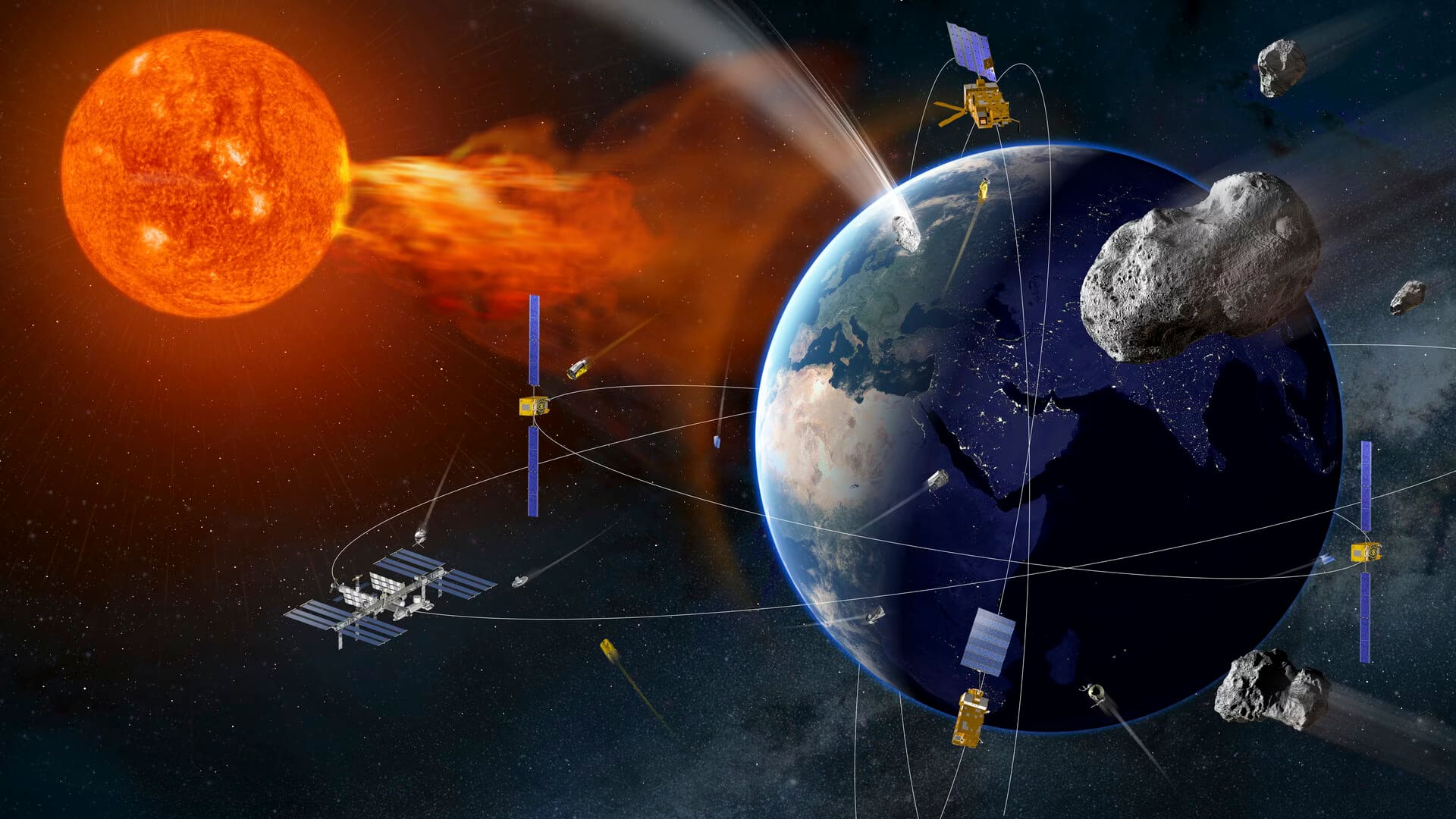
Our modern world is intricately woven with infrastructure in orbit. From global navigation and communication to critical climate studies, our reliance on satellites is a marvel of the 21st century. Yet, this dependency is increasingly fragile. Hazards originating in space—both natural and human-made—pose a significant risk, threatening to derail everyday life with sudden and devastating effect. The European Space Agency (ESA) is proactively addressing these challenges through its dedicated Space Safety Programme, a comprehensive initiative designed to protect our planet, society, and assets from celestial threats. The core mission of the programme is to detect, predict, and mitigate these dangers, ranging from natural events like asteroid impacts and severe solar storms to the growing, human-made problem of space debris.
1. The Challenge: Why Space Safety is a Global Imperative
Understanding and managing the risks inherent in space operations is a strategic imperative. In an era of geopolitical instability, ensuring Europe has independent, continuous access to critical data and satellite services is paramount. Earth’s orbital environment is a finite, shared resource that is growing more congested and hazardous each year, demanding a proactive approach to control these threats and reverse the deterioration of the space environment. The hazards are dual in nature, originating from both the cosmos and our own activities within it.
1.1. Cosmic Dangers: Asteroids and Solar Storms
Natural phenomena present the potential for sudden, large-scale disruption. Unpredictable solar outbursts can trigger severe space weather events that threaten critical infrastructure, both in space and on the ground, affecting everything from power grids to satellite services. Similarly, the constant possibility of an asteroid impact, while statistically rare, remains a high-consequence threat that we must prepare for. These cosmic dangers underscore the need for constant vigilance and a robust planetary defense capability.
1.2. The Orbital Junkyard: The Threat of Space Debris
The orbits around Earth are becoming an increasingly crowded junkyard. Decades of space activity have left a legacy of defunct satellites, spent rocket stages, and fragments from in-orbit collisions. Space surveillance networks currently track about 40,000 objects, but statistical models estimate there are over 50,000 objects larger than 10 cm and over 1.2 million pieces of debris larger than 1 cm—each capable of causing catastrophic damage to an operational satellite. This escalating population of space junk heightens the risk of a cascade of collisions, a self-perpetuating, “runaway chain reaction, known as Kessler syndrome,” which could render certain orbits unusable for generations. Alarming projections show that even if all space launches were to cease today, the amount of debris would continue to grow as existing objects collide and fragment. This makes debris mitigation and active removal essential for the future of spaceflight.
To counter these escalating threats, ESA has structured its response around a clear, mission-focused strategy.
2. A Three-Pillared Defense: The Cornerstones of the Space Safety Programme
ESA’s Space Safety Programme is built upon three mission-focused “Cornerstones,” each designed to address a primary goal: Planetary Defence, Space Weather, and Active Debris Removal & In-Orbit Servicing (ADRIOS). This three-pillared strategy represents a comprehensive approach to securing our future in space, protecting against external threats while ensuring the long-term sustainability of our orbital environment. Together, these pillars help secure Europe’s position at the forefront of new space technologies, driving innovation and stimulating a competitive European space industry.
2.1. Planetary Defence: From Theory to Practice
The Planetary Defence Cornerstone aims to move beyond science fiction and develop a tangible, real-world asteroid deflection capability before it is urgently required. Honing this skill establishes Europe as a key global partner in planetary protection.
- Hera: Launched in October 2024, ESA’s Hera mission is a crucial follow-up to NASA’s successful Double Asteroid Redirection Test (DART). Hera will journey to the Didymos binary asteroid system to conduct a detailed investigation of the DART impact on the moonlet Dimorphos. By gathering data on the crater’s size, the asteroid’s mass, and its structural composition, Hera will turn humanity’s first test of kinetic impact deflection into a well-understood and repeatable planetary defence technique.
- Ramses: The world will be watching in 2029 as the asteroid Apophis makes a remarkably close pass of Earth. Capitalizing on this rare event, ESA’s Ramses mission, with key support from JAXA, will observe Apophis up close, testing our reconnaissance capabilities under realistic, high-pressure time constraints. Its fixed 2028 launch window mimics the tight timeline of a real deflection scenario, providing an invaluable opportunity to test our readiness.
2.2. Space Weather: A Sentinel for Solar Storms
The goal of the Space Weather Cornerstone is to enable economic continuity by protecting our critical infrastructure from the harmful effects of solar storms. ESA’s Vigil mission is a game-changer for space weather forecasting, positioned at a unique vantage point in deep space—the fifth Lagrange point (L5)—where it will monitor the Sun’s surface before it rotates into view from Earth. This strategic placement will provide an unprecedented 4-5 days of advance warning of potentially hazardous solar storms, giving operators of power grids, aviation, and financial systems the time needed to take protective measures and prevent massive economic disruption. As the first mission to stream operational data 24/7 from deep space, Vigil’s game-changing impact is underlined by the contribution of key instruments by NASA and NOAA, as well as strong interest in future collaboration from Korean, Japanese and Indian space agencies.
2.3. ADRIOS: Cleaning Up Our Orbit and Building a New Market
The Active Debris Removal & In-Orbit Servicing (ADRIOS) Cornerstone is dedicated to ensuring the sustainable use of space. Its missions are designed not only to demonstrate cleanup technologies but also to pioneer a new commercial market for in-orbit services.
- ClearSpace-1: This groundbreaking mission will be the first ever to capture and remove an uncooperative, unprepared piece of space debris from orbit. In doing so, ClearSpace-1 will demonstrate the complex sensors and critical technologies—such as relative navigation and close-proximity operations—that are essential for future large-scale cleanup efforts.
- RISE: As a commercial in-orbit servicing demonstrator, the RISE mission will prove its ability to safely rendezvous with and dock to a client satellite in geostationary orbit. This capability is foundational for a host of future services.
Ultimately, the ADRIOS missions are about more than just cleaning up our orbital backyard. They are a direct investment actively building the foundation for European leadership in the future multi-billion-euro in-orbit servicing market. These pioneering ADRIOS missions, which are the first practical steps toward a sustainable orbital environment, are built upon a foundation of core technological development managed under the COSMIC framework.
3. Building Capability: The COSMIC Framework
The ambitious Cornerstone missions are not developed in a vacuum. They are enabled by COSMIC, six cross-cutting areas of activity that develop the specific technologies and services required for their success. They represent the foundational work that makes the headline missions possible.
- Develop Space Weather Services: Maturing space weather monitoring services to deliver reliable forecasts and ‘nowcasts’ that allow for the mitigation of solar storm effects, services that will ultimately turn the raw data from the Vigil mission into actionable warnings for European citizens and industry.
- Space Weather Sensors: Ensuring accurate, real-time data is available from varied satellite missions to power effective space weather services.
- Predict Asteroid Impacts: Improving asteroid detection capabilities on the ground and in space, as well as refining risk assessment methods to identify potential threats in time.
- Technologies For Increased Space Traffic: Developing key tracking and collision avoidance technologies to manage an increasingly congested space environment, key technologies that directly enable the complex rendezvous and proximity operations of the ADRIOS missions like ClearSpace-1.
- Towards A Clean and Zero Debris Future: Stimulating technology development through the implementation of stringent standards and policies for ESA’s future missions, developing the very technologies that make the goals of the ADRIOS Cornerstone and the Zero Debris approach achievable.
- Competitiveness: Fostering innovation through an open call system that accelerates the transformation of new technologies into market-ready products and services.
These foundational activities pave the way for ESA’s ultimate vision for a sustainable orbital environment.
4. The Vision for Tomorrow: ESA’s ‘Zero Debris’ Commitment
In response to the clear inadequacy of current international debris mitigation measures, ESA has adopted a bold, forward-looking policy known as the “Zero Debris” approach. This initiative recognizes that simply slowing the rate of pollution is no longer sufficient to prevent the Kessler syndrome. A more ambitious strategy is required, one that actively cleans our orbital environment and sets a new global standard for responsible space operations.
The core tenets of the Zero Debris approach are clear and ambitious:
- Invert Europe’s contribution to space debris by 2030.
- Acknowledge that prevention is not enough; active debris removal is now required.
ESA is leading this charge by example. The agency is advancing the technology needed to maintain a clean orbital environment, updating its own stringent mitigation requirements for all ESA missions, and fostering a global community of action through the Zero Debris Charter. This community-driven charter has already been signed by 19 countries and over 150 commercial and non-commercial entities, uniting them in a shared commitment to the long-term sustainability of space activities and ensuring that our progress in space does not come at the cost of the environment.
5. Conclusion: A Proactive Shield for a Sustainable Future
ESA’s Space Safety Programme is a comprehensive and proactive strategy designed to safeguard our modern way of life. It is a multi-faceted shield that protects against both distant cosmic threats and the consequences of our own activities closer to home. By combining vital missions for Planetary Defence and Space Weather with a powerful commitment to orbital sustainability through ADRIOS and the Zero Debris approach, ESA is tackling the full spectrum of space hazards.
This programme is not only crucial for protecting the critical infrastructure that powers our global economy but also for fostering new commercial opportunities in emerging markets like in-orbit servicing, satellite life extension, and active debris removal. By ensuring that space remains a safe, sustainable, and accessible resource, the Space Safety Programme protects our present and secures our future in orbit for generations to come.
Discover more from Pasindu Lakshan Perera
Subscribe to get the latest posts sent to your email.

Related Posts

An Architectural Blueprint for Future Orbital Disaster Response

Inside the First AI-Planned Drive on Mars
