
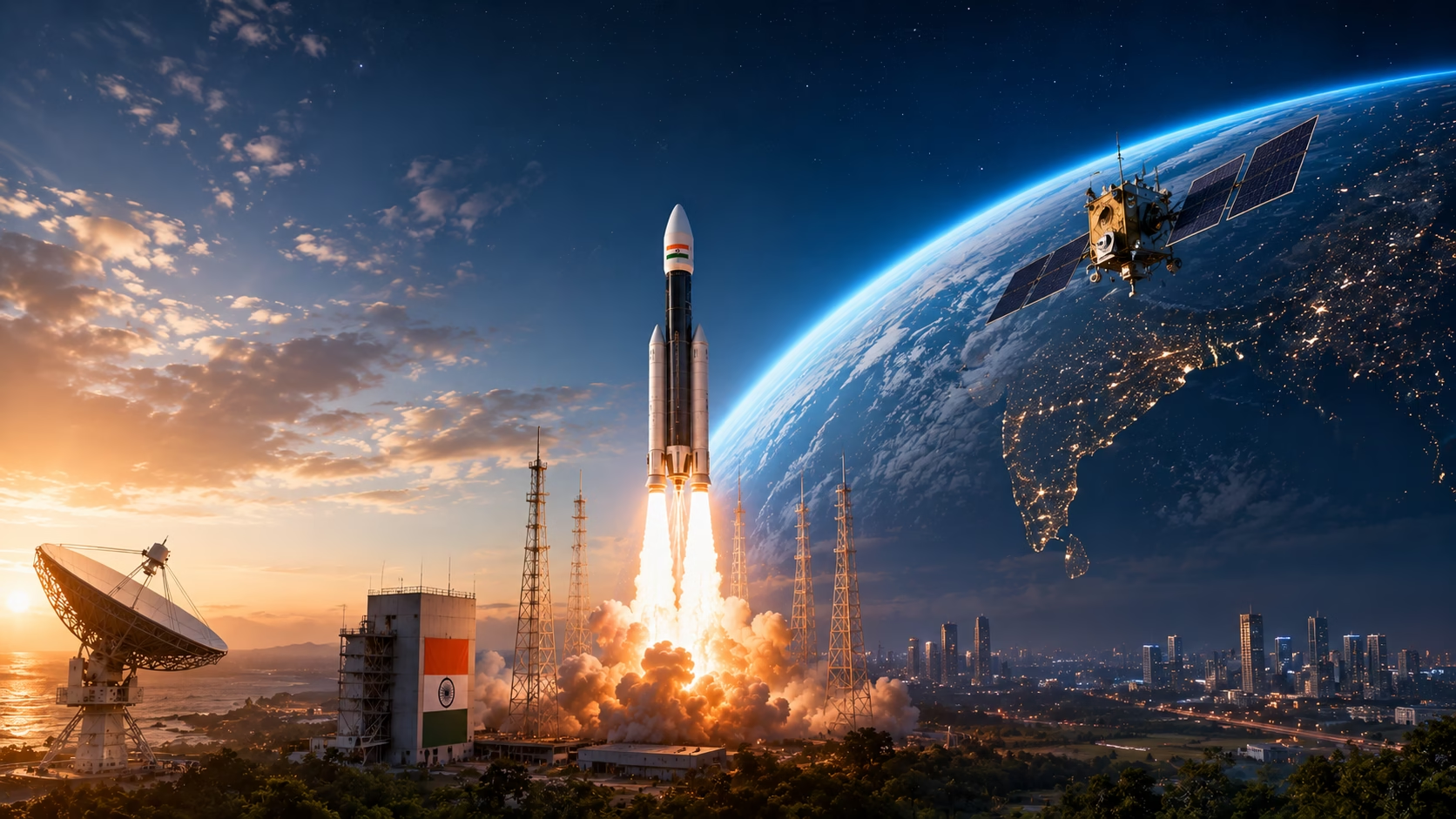
The Strategic Pivot of the Indian Space Program
India’s space trajectory has reached a critical strategic inflection point, transitioning from a state-led developmental program into a high-prestige, commercial powerhouse. This pivot was catalyzed by two paradigm-shifting milestones: the historic soft landing of Chandrayaan-3 on the lunar South Pole and the successful orbital launch of Vikram-1 on July 18, 2026. These events did more than assert technological maturity; they signaled the arrival of a “full-stack” NewSpace contender capable of capturing significant global market share.
The evolution of India’s space journey can be distilled into three distinct strategic phases:
- Phase I: Socioeconomic Development (1960s–Mid-2000s): A focus on indigenous self-reliance, leveraging orbital assets for telecommunications, meteorology, and natural resource management to drive national growth.
- Phase II: Prestige and Strategic Competition (Mid-2000s–2020): High-profile scientific missions, including Chandrayaan-1 and the Mars Orbiter Mission (Mangalyaan), designed to project soft power and respond to regional geopolitical shifts.
- Phase III: The Commercial NewSpace Era (2020–Present): Defined by aggressive vertical integration of the private sector, regulatory liberalization, and the pursuit of global commercial dominance.
This era is governed by the “10% Vision” set by ISRO Chairman S. Somanath, which aims to expand India’s share of the global space economy from 2% to 10% within a decade. This strategic roadmap anticipates the domestic sector scaling from $9 billion to a $45 billion valuation by 2033, fueled by a relentless influx of private capital and a radical rethinking of state-private participation.
Capital Inflows and the Rise of SpaceTech Unicorns
Venture capital is no longer a peripheral participant in Indian space; it is the sector’s primary engine. The flooding of private equity is fundamentally altering the competitive landscape, shifting the focus from state-dictated projects to agile, market-driven innovations. This transition has been supercharged by the 2024 FDI policy liberalization, which permitted 100% foreign investment in space component manufacturing and up to 74% in satellite activities under the automatic route. Furthermore, the March 2025 landmark agreement between Starlink, Reliance Jio, and Bharti Airtel has signaled a tectonic shift in downstream commercial participation, effectively de-risking the sector for global institutional investors.
The following data illustrates the unprecedented acceleration of capital deployment:
| Metric | 2021 Performance | 2025/2026 Performance (through July 2026) |
| Total Funding (Annual) | $43 Million | $200 Million (2025) / $113 Million (2026 YTD) |
| Funding Rounds | 12 Rounds | 53 Rounds (2025) |
| Cumulative Ecosystem Funding | — | $871 Million (Total raised to date) |
| Late-Stage Funding | $0 | $17 Million (2025) / $53 Million (2026 YTD) |
The Unicorn Milestone: Skyroot Aerospace
In May 2026, Skyroot Aerospace achieved unicorn status with a valuation exceeding $1.1 billion. With $150 million in total funding, Skyroot has become a primary driver of investor sentiment, proving that Indian private ventures can successfully navigate the capital-intensive path to orbital capability.
The Hub Hierarchy
Innovation is concentrating within high-density ecosystems, creating a specialized hub hierarchy:
- Bengaluru ($495 Million): The dominant epicenter, hosting seven of the nation’s top ten funded SpaceTech firms. Its ecosystem is anchored by Pixxel, which represents nearly 19% of the city’s total capital.
- Hyderabad ($205 Million): A center for launch and satellite integration, where Skyroot Aerospace and Dhruva Space command 87% of the city’s investment.
- Chennai ($80 Million): An emerging hub with high vertical specialization, led by AgniKul Cosmos, which accounts for 95% of the local investment.
From State Monopoly to Tripartite Governance
The Indian Space Policy 2023 and the subsequent establishment of IN-SPACe have dismantled the traditional state monopoly, replacing it with a tripartite governance structure designed for commercial agility. This reform separates R&D from regulation and commercialization, creating a predictable environment for private enterprise.
Regulatory Reform Breakdown
- ISRO (R&D): Focuses on “frontier” research, deep-space exploration, and the transfer of mature technologies (such as the SSLV rocket) to the private sector for mass production.
- IN-SPACe (Regulatory/Authorization): An autonomous “single-window” interface that authorizes all private activities, ensuring alignment with national security and global norms.
- NSIL (Commercialization): The corporate arm tasked with the high-volume commercialization of ISRO’s technological portfolio.
The Sustainability Rulebook
In July 2026, IN-SPACe issued rigorous “re-entry” guidelines to position India as an emerging norm-shaper in space sustainability. These protocols mandate a casualty risk requirement of less than one in 10,000 for any planned de-orbiting and require mandatory third-party insurance to insulate the state from liability under the 1972 Liability Convention.
Strategic Autonomy vs. Global Alignment
India is masterfully balancing its traditional doctrine of “Strategic Autonomy” with strategic alignment. While its 2023 signing of the U.S.-led Artemis Accords signals an intent to shape the norms of lunar governance, India remains a vocal champion for the Global South. This is demonstrated through its “Neighborhood First” policy, exemplified by the South Asia Satellite (GSAT-9), and the G20 climate observation proposal, which ensures that the benefits of space technology remain inclusive and non-discriminatory.
Launch Vehicles and Geospatial Intelligence
India is rapidly maturing as a “full-stack” space power, combining indigenous launch capabilities with world-leading geospatial analytics. This dual-use capability is a critical “Force Multiplier” in Network-Centric Warfare, as articulated in the 2017 Joint Doctrine of the Indian Armed Forces.
Orbital Capability Milestones
The Vikram-1 orbital launch on July 18, 2026, was a watershed for private industry. Placing four payloads into a 450-km low Earth orbit, the mission featured a collaborative roster including Grahaa Space, DCubed, Cosmoserve, and the SCOPE satellite. This success makes India one of only three nations (with the U.S. and China) to possess a privately developed orbital launch capability.
EO Innovation: The OptoSAR Breakthrough
On May 3, 2026, GalaxEye launched “Mission Drishti” via a SpaceX Falcon 9 rocket. This mission deployed the world’s first OptoSAR satellite, which fuses:
- Optical Imaging: High-resolution visible light data.
- Synthetic Aperture Radar (SAR): Radar-based imaging capable of penetrating cloud cover and operating in total darkness.
This fusion technology provides “all-weather” surveillance, a strategic necessity for defense and disaster response in the region.
The Data-as-a-Service (DaaS) Shift
Industry leaders like SatSure and Pixxel are pivoting from hardware to AI-driven intelligence. By leveraging hyperspectral and radar data, these firms provide subscription-based “Decision Intelligence” that transforms:
- Agriculture: Enabling crop analytics and credit scoring for the unbanked.
- Insurance: Refining risk models for climate-related disaster avoidance.
- National Security: Enhancing intelligence, surveillance, and reconnaissance (ISR) capabilities.
The Road to 2040 and the Global Space Order
India’s vision for the next two decades is a statement of intent: a human space station by 2035 and an Indian on the Moon by 2040. For global stakeholders, India is no longer a peripheral participant but a pivotal architect of the new orbital order.
Critical Strategic Takeaways:
- Emerging Norm Shaper: Through its leadership in the UN’s Long-Term Sustainability (LTS) working group and its own rigorous re-entry guidelines, India is proactively defining the rules of responsible space behavior.
- Economic Multiplier: Each rupee invested in the space sector yields a 2.5x economic impact, driving high-value job creation and enhancing efficiencies in fisheries, agriculture, and disaster management.
- The Global Ambition: While a 45 billion domestic target is ambitious, it represents a calculated attempt to capture a strategic slice of the projected **1.8 Trillion global space economy by 2035**.
Based on current momentum, liberalized FDI, and the successful maturation of the private launch sector, India’s $45 billion valuation target is not merely achievable—it is the floor for a nation redefining the rules of engagement on the final frontier.
Discover more from Pasindu Lakshan Perera
Subscribe to get the latest posts sent to your email.

Related Posts

The “Ant” Exodus: Deconstructing South Korea’s Retail Investment Crisis and the Macroeconomic Fallout

Navigating the Strategic Challenges of NASA’s Nuclear Future