The Predatory Nature of Naval Warfare
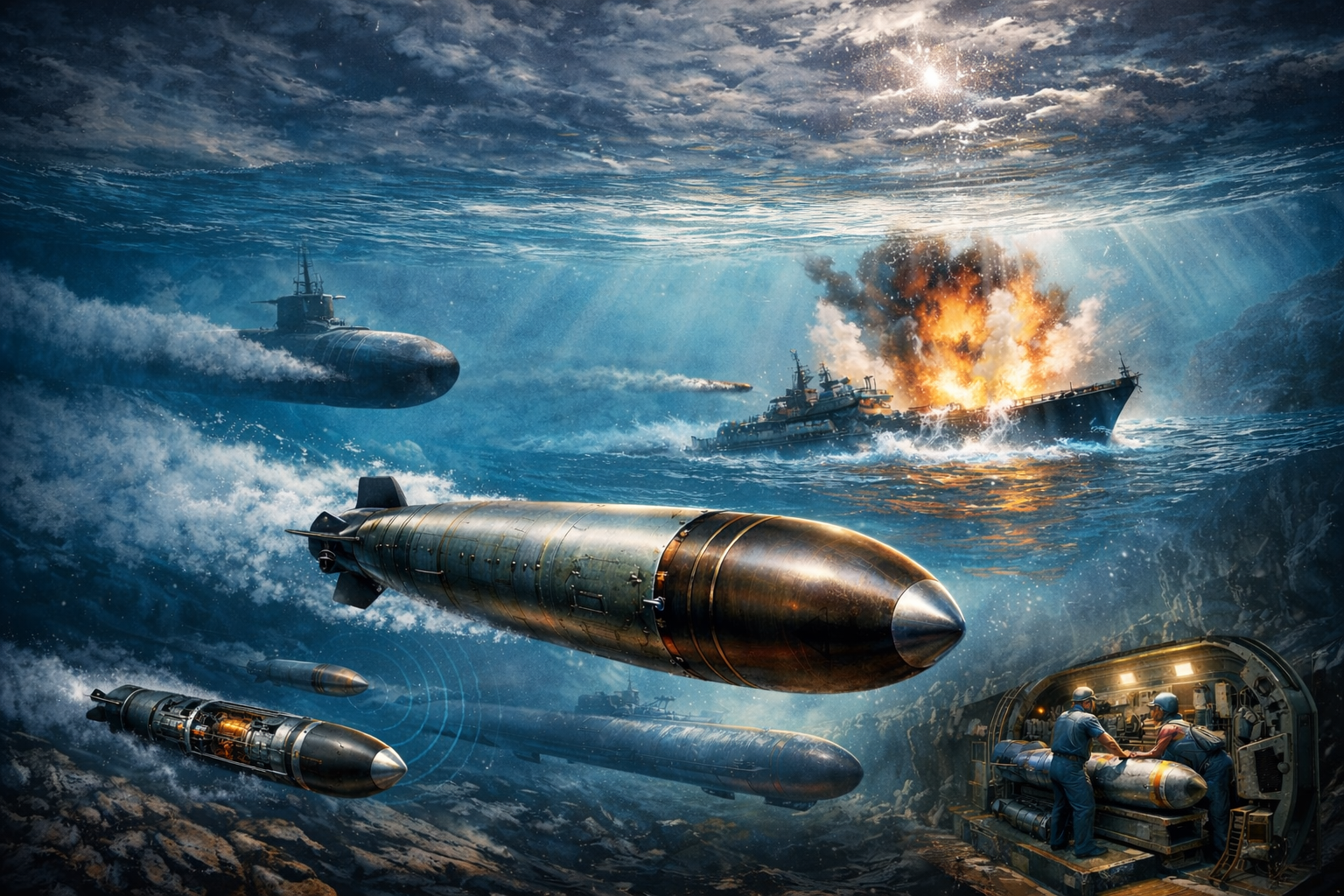
The torpedo is not merely a weapon of opportunity; it is the primary instrument of stealth based maritime denial. Its emergence fundamentally altered naval doctrine by shifting the center of gravity from visible surface engagements where armor and caliber dictated victory to the lethal, unseen depths of the undersea domain. This transition forced a global revolution in naval architecture, as the threat of a single underwater strike compelled navies to prioritize internal hull compartmentalization and anti-torpedo shielding against an enemy that strikes without warning.
Technically, a torpedo is a self-propelled, underwater missile designed to navigate toward and destroy surface or sub-surface targets. Its strategic value is distilled into three core advantages:
- Stealth: The capacity to approach a target undetected, often leaving no visible wake or acoustic signature until the final seconds of an engagement.
- Lethality: Underwater explosions leverage the incompressibility of water to deliver a massive “bubble pulse,” capable of breaking the structural spine of capital ships or crushing the pressure hulls of submarines.
- Versatility: As a cross-domain threat launched from aircraft, surface vessels, or submarines, it forces adversaries to dedicate disproportionate resources to anti submarine warfare (ASW).
Modern torpedoes are marvels of digital intelligence, yet their current dominance is the result of over a century of high-stakes innovation, where propulsion provides the reach, but intelligence provides the lethality.
Historical Evolution: From Robert Whitehead to the Cold War
The late 19th and early 20th centuries were defined by a technological arms race that forced navies to adapt to a weapon they could not see. The genesis of modern underwater warfare began in 1866 with Robert Whitehead’s invention of the first self propelled torpedo. Its impact was immediate and profound; the mere existence of a weapon capable of striking beneath the waterline forced the introduction of anti-torpedo nets and thick “torpedo bulges” on the hulls of capital ships, a major shift in late-Victorian naval architecture.
While early torpedoes were steam driven using compressed air and alcohol the need for stealth led to the “Electric Revolution.” Steam engines produced a telltale wake of bubbles that could alert a target; electric motors offered a “wakeless” alternative. This transition drew upon a deep pedigree of American electrical engineering; for instance, the Electric Storage Battery Company (Exide), which played a crucial role in World War II, had manufactured the batteries for the U.S. Navy’s first submarine, the USS Hunley, as early as 1899.
The Mark 18 Development Cycle (1931–1945)
| Timeline | Key Partner | Technical Milestone/Challenge |
| 1919–1931 | Naval Torpedo Station (NTS) | Initial development of electric-drive; suspended due to Great Depression funding cuts. |
| July 1941 | NTS, GE, Exide | Project restarted; Exide leveraged history (back to USS Hunley) for battery tech. |
| Jan 1942 | British Royal Navy | Captured German G7e electric torpedo provided to U.S. for deconstruction. |
| 1942 (15 weeks) | Westinghouse, Exide | Westinghouse delivered 5 prototypes by reverse-engineering the German G7e design. |
| Nov 1942 | NTS (Newport) | Testing required new light systems to track “wakeless” weapons during night trials. |
| April 1943 | Westinghouse (Sharon, PA) | First production units completed; adapted for U.S. submarine firing systems. |
| Sept 1943 | U.S. Submarine Fleet | First Pacific deployment; despite early issues, it became the fleet’s primary weapon. |
The Mark 18 was a strategic triumph, accounting for 65% of all submarine torpedoes fired in the Pacific by 1945. Simultaneously, German innovation reached its zenith with Rudeltaktik (Wolfpack) tactics and the deployment of the G7es Zaunkönig (T5) passive acoustic torpedo in 1943. The Allies responded with the Mark 24 acoustic mine and the “Foxer” noisemaker. The capture of U-505 and U-250 in 1944 provided the Allies with direct access to German homing logic, accelerating the mechanical and electrical foundations for the sophisticated propulsion systems of the 21st century.
The Mechanics of Lethality: Propulsion and Stealth
Modern torpedo design involves a relentless trade off between speed, range, and acoustic signature. A faster torpedo can catch a nuclear powered target but is easily detected; a quieter weapon can strike by surprise but may be outrun by a target alerted at the last moment.
Thermal vs. Electric Propulsion
| Feature | Thermal Torpedoes (e.g., OTTO Fuel II) | Electric Torpedoes (e.g., DM2A4 Sea Hake) |
| Speed Capability | High (60+ knots with HAP boost) | Moderate (Standardized at 50 knots) |
| Range | Superior (High energy density liquid fuel) | Variable (Depends on battery modularity) |
| Acoustic Signature | Moderate (Reduced by gas turbines) | Very Low (Inherently quiet electric motors) |
| Startup Lag | High (Mechanical inertia/combustion lag) | Low (Instant torque; ramps up in <1 second) |
The “Silence Factor” remains the ultimate metric. In a major evolutionary leap, high-speed gas turbine engines have largely replaced older external combustion, axial piston-driven engines. These turbines, combined with chassis silencing and exhaust modifications, have made modern thermal torpedoes nearly as quiet as the submarines that launch them. Consequently, a target may never detect the weapon until it transitions into its terminal homing phase.
Intelligence in the Deep: Guidance and Homing Logic
Labeling a torpedo “fire-and-forget” is a gross oversimplification. Modern engagements rely on a complex, continuous data link via command wires or fiber optic cables. This allows the fire control operator to use the submarine’s superior sonar suite to override the torpedo’s “lower-fidelity” onboard sensors, ensuring the weapon ignores decoys.
The three primary pillars of target detection include:
- Passive Sonar: The weapon “listens” for machinery noise or propeller cavitation. So What? It is undetectable, negating the target’s ability to initiate early-stage defensive maneuvers.
- Active Sonar: The torpedo emits high-frequency pings to find targets. So What? While it alerts the target, modern logic circuitry filters through enemy jammers and maskers to maintain a lock.
- Wake Homing: The weapon detects the turbulent trail left by a surface ship’s propellers. So What? Because it follows a physical disturbance rather than a sound, it is exceptionally difficult to counter with standard acoustic decoys.
As the weapon closes, the “Doomsday Clock” begins—the terminal phase where the active sonar pinging interval rapidly shortens as the distance to the hull decreases. At this stage, the weapon uses combination fusing: proximity fusing (magnetic or distance measured) to detonate beneath the keel, or contact fusing for a direct strike. The resulting explosion is designed to break the back of even the most modern warship.
Tactical Reality vs. Cinematic Fiction
Underwater combat is rarely the frantic “dogfight” seen in Hollywood. Cinematic tropes of submarines “shaking” a torpedo through aggressive maneuvers are largely fictional; modern engagements are sterile, silent affairs defined by “first shot, first kill” lethality.
The “Kill Box” Doctrine is the operational standard. Fire control operators define a three-dimensional “kill box” a precise geometric volume of water where the torpedo is authorized to activate its sensors. This is a critical safety protocol, not just a search area; it prevents the weapon from circling back to strike the firing submarine (self-targeting) or attacking neutral shipping.
The myth of the dogfight is debunked by three realities:
- Stealth: If launched and maintained in passive mode, the target receives zero reaction time before impact.
- Digital Beamforming: Modern sonars scan wide arcs without the “snake-like” maneuvering of older weapons, maintaining maximum speed.
- Low Reaction Time: By the time a target hears the terminal active ping, the torpedo is at maximum velocity and too close for countermeasures to deploy.
The Sinking of the Iris Dena (March 2026)
The sinking of the Iris Dena in March 2026 stands as a watershed moment in 21st-century naval history, marking the first torpedo sinking of an enemy warship since 1945. The strike occurred 44 nautical miles off the coast of Galle, Sri Lanka. A U.S. submarine launched a Mark 48 heavyweight torpedo at the Iranian frigate as it returned from exercises in the Bay of Bengal.
Pentagon officials, including Defense Secretary Pete Hegseth, characterized the strike as a “quiet death.” Technical analysis of the strike reveals several critical implications:
- The Weapon: The Mark 48 ADCAP demonstrated its ability to definitively kill a modern warship equipped with advanced surface-to-air defenses.
- The EW Component: Iranian claims that their defense capabilities were “disabled by electromagnetic means” suggest a new era of electronic warfare integration, where kinetic torpedo strikes are preceded by the electromagnetic blinding of the target’s sensors.
- Tactical Prowess: The strike proved that even in international waters, a high-value asset can be eliminated before it can mount a defense.
The Frontier: AI, UUVs, and Autonomous Decision Making
As warfare moves into communication-denied environments, the strategic focus is shifting toward Unmanned Undersea Vehicles (UUVs). These represent the next evolutionary step: autonomous weapon carriers that remove human operators from the danger zone. UUVs enable “self organized cross-domain cooperation” and “autonomous swarm confrontation,” where multiple units coordinate to overwhelm a target’s defenses.
However, removing the human operator requires AI to solve critical problems, particularly in complex, shallow water, noisy, and icy environments where acoustic fidelity is low:
- Observation Data Uncertainty: AI must filter through environmental background noise (like ice cracking or coastal clutter) without human intuition.
- Real-Time Decision-Making: Calculating attack geometry and counter-countermeasure profiles in milliseconds.
- Weak Interaction Perception: Managing weapon behavior when the sonar return is degraded by environmental stressors.
This AI integration is the logical conclusion of a journey that began with the first primitive acoustic sensors in 1943.
Conclusion: The Unseen Arbiter of Sea Power
The torpedo remains the most lethal and stealthy component of naval warfare. From its 19th century origins as Robert Whitehead’s mechanical marvel to the AI-driven UUVs and heavyweight Mark 48s of today, it has consistently dictated the terms of maritime engagement. As the sinking of the Iris Dena vividly demonstrates, even in an era of satellite surveillance and missile defense, the “silent death” from below remains the ultimate arbiter of sea power and the primary tool for maintaining maritime order.
Discover more from Pasindu Lakshan Perera
Subscribe to get the latest posts sent to your email.

Related Posts

The “Ant” Exodus: Deconstructing South Korea’s Retail Investment Crisis and the Macroeconomic Fallout

Analyzing the Exponential Rise of the Indian Space Ecosystem