Executive Summary of a Planetary Milestone
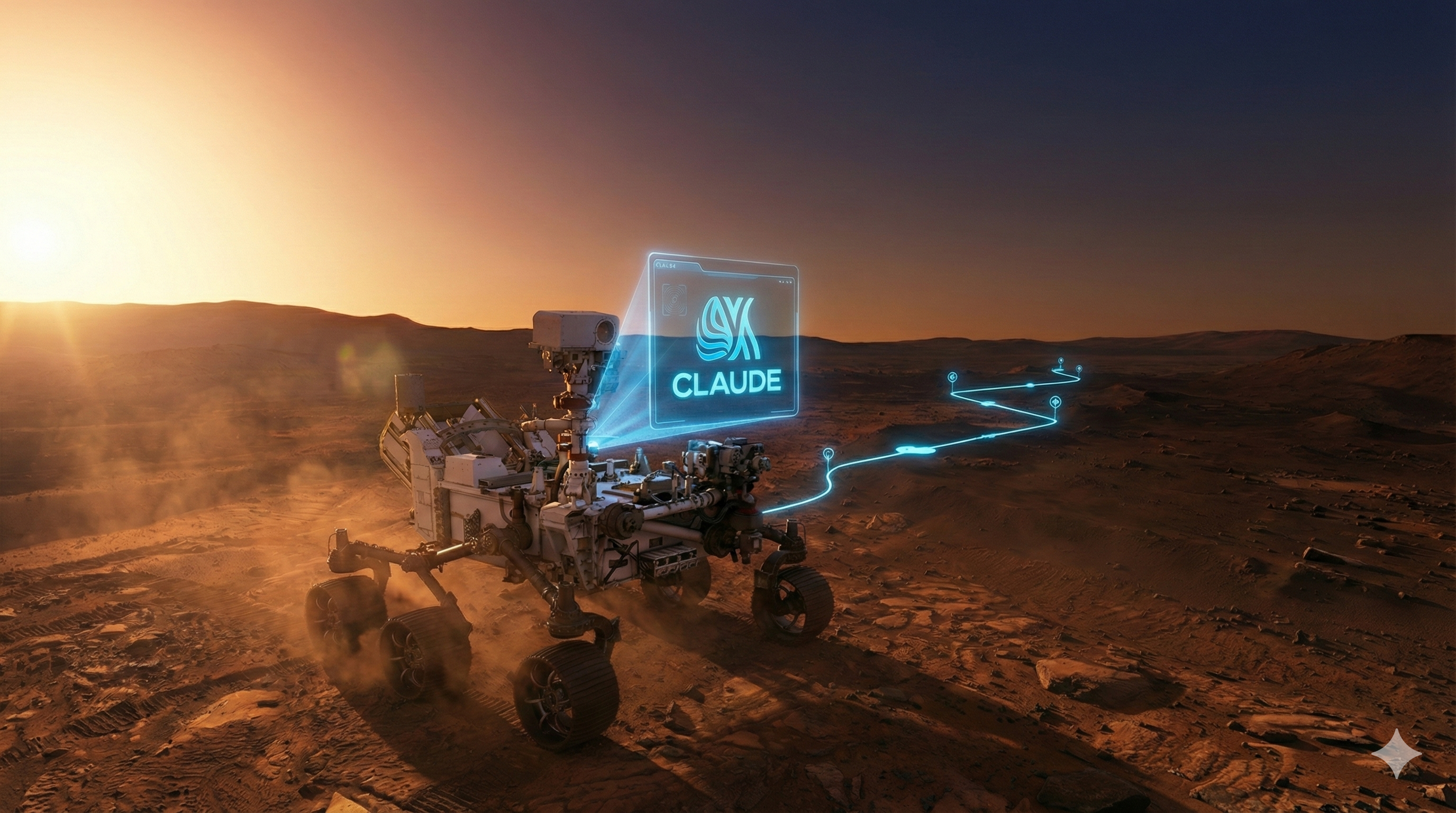
In December 2025, the paradigm of interplanetary exploration underwent a fundamental shift as NASA transitioned from human-mapped “breadcrumb trails” to generative AI-synthesized waypoints. For nearly three decades, Martian surface navigation has been a labor-intensive manual process, constrained by the high stakes of multi-billion-dollar mission assets. However, the successful autonomous navigation of the Perseverance rover through the Jezero Crater utilizing routes fully conceptualized by Anthropic’s Claude AI, marks a historic pivot. This transition represents a move from reactive obstacle avoidance to proactive, high-level mission synthesis, providing a critical solution to the fundamental bottleneck of deep-space exploration.
Mission Profile: Extraterrestrial AI Navigation Test
- Dates: December 8 and December 10, 2025
- Martian Sols: 1707 and 1709
- Total Distance Traversed: ~400 meters (Segments of 210m and 246m)
- Primary Technology: Anthropic’s Claude AI (Vision-Language Model) and NASA JPL’s Digital Twin simulation environment.
The strategic necessity of this test is dictated by the immutable laws of physics: the 20-minute communication delay between Earth and Mars renders real-time “joystick” driving impossible. At a distance of 360 million kilometers, the ability for a Vision-Language Model (VLM) to analyze terrain and produce executable code locally is the only path toward true mission scalability. The following analysis details the architecture that allowed an LLM to bridge the gap between abstract reasoning and the physical control of a Martian rover.
The Architecture of Autonomy: How Claude Navigated Jezero Crater
Traditional “AutoNav” systems are inherently reactive; they excel at local obstacle avoidance using the rover’s immediate perspective but lack the capacity for high-level route synthesis. To achieve an asymmetric workforce advantage, JPL engineers utilized Claude as a Vision-Language Model (VLM) to perform wide-area strategic planning. By ingesting and synthesizing orbital imagery from the High Resolution Imaging Science Experiment (HiRISE) camera alongside terrain-slope data from digital elevation models (DEMs), Claude identified high-level hazards—including bedrock outcrops and treacherous boulder fields—well before the rover’s local sensors could detect them.
The integration utilized a specialized “Coding for Mars” layer via the Claude Code environment. Claude did not merely describe a path; it synthesized executable commands in Rover Markup Language (RML), a bespoke XML-based instruction set. A critical strategic feature was the AI’s autonomous self-critique phase. Claude partitioned the journey into 10-meter segments, iteratively reviewing its own RML code to refine waypoints. This recursive verification is essential for reducing “hallucination” risks in code generation, ensuring that every command string was optimized for the specific mechanical constraints of the Perseverance chassis.
This technical maturation translated into measurable mission progress. On December 8 (Sol 1707), the rover navigated 210 meters of AI-planned terrain; on December 10 (Sol 1709), it completed a 246-meter segment. While these distances prove Claude can master the “Martian language” of hardware, the high stakes of planetary science required a rigorous verification protocol to ensure the safety of this multi-billion-dollar asset.
The “Digital Twin” Protocol: Verification and Human Oversight
In the high-consequence environment of deep-space robotics, the governing philosophy remains “Trust but Verify.” Human-in-the-loop remains non-negotiable for high-stakes maneuvers. To validate the AI’s synthesis, JPL engineers employed a “Digital Twin” protocol a high-fidelity virtual replica of Perseverance used to stress-test the AI-generated RML code before transmission via the Deep Space Network.
The scale of this verification effort was unprecedented, modeling over 500,000 telemetry variables to predict position changes and mechanical stress. This protocol identified a vital nuance: while Claude’s vision-language synthesis was accurate based on the orbital data provided, it lacked access to a ground level Hazcam perspective. These ground-level views revealed specific sand ripples flanking a narrow corridor that required human fine-tuning. This highlights a critical strategist’s takeaway: AI provides the high-level operational tempo, while human oversight provides the granular “ground-truth” refinement.
Human vs. AI Navigation: A Collaborative Breakdown
| Navigation Task | AI Contribution (VLM Synthesis) | Human Oversight/Verification |
| Hazard Identification | Analyzes orbital HiRISE/DEM data to identify outcrops and boulder fields. | Cross-references AI findings with Hazcam ground-level imagery. |
| Path Planning | Generates continuous waypoints and 10-meter instruction segments. | Models 500,000+ variables in a Digital Twin to verify rover stability. |
| Command Generation | Writes and self-critiques specialized RML (XML-based) code. | Conducts final code review and validates RML syntax against flight software. |
| Safety Adjustments | Optimizes route for efficiency and known orbital hazards. | Manually adjusts for fine-grained terrain details like sand ripples. |
The Strategic “So What?”: Efficiency in an Era of Constraints
The integration of generative AI is a fundamental mitigation strategy for NASA’s current “budget-constrained winter.” The agency is navigating a 20% workforce reduction—totaling 4,000 employees making traditional, labor-intensive planning cycles a primary mission-critical bottleneck. In this context, Claude acts as a “force multiplier,” allowing a depleted workforce to maintain a high operational tempo.
JPL estimates that AI integration can halve the time required for route planning. This “halving of planning time” does not just reduce man-hours; it directly accelerates “science return.” By increasing the daily operational velocity, Perseverance can visit more outcrops, collect more rock samples for the Mars Sample Return mission, and perform more spectral analyses in the same mission window. In an era of shrinking budgets and staff, AI-driven efficiency is the only way to sustain the search for signs of ancient life in the Jezero Crater without compromising safety.
Future Horizons: From Artemis to Deep Space
The success of this “interstellar navigator” on Mars sets the stage for missions to Europa or Titan, where communication delays stretch into hours or days. In these environments, solar power is unviable, and energy margins are razor-thin. Autonomous decision-making is not just a convenience; it is a survival requirement. An AI must be capable of making real-time course corrections before environmental factors or battery depletion terminalize the mission.
This technology is a cornerstone of the Artemis Moon missions, where the goal is to graduate to “kilometer scale drives” with minimal direct intervention. AI will be integrated across the lunar south pole infrastructure:
- Life-Support Monitoring: Autonomous management of complex environmental systems in pressurized habitats.
- Autonomous Mining: Real-time identification and extraction of lunar volatiles and regolith for In-Situ Resource Utilization (ISRU).
- Resource Allocation: Smart prioritization of power and thermal management in extreme lunar night cycles.
This milestone represents the maturation of “physical intelligence.” The rapid evolution of Claude—from struggling with the logic of “Pokémon Red” to navigating the hazardous terrain of another planet—serves as a metaphor for the escalating capabilities of AI in physical control systems.
Ethical Foundations and Regulatory Challenges
As AI assumes greater autonomy in environments where human presence is impossible, we face a new frontier of accountability. The deployment of autonomous agents in space raises three core challenges that must be addressed by the international community:
- Responsibility and Accountability: Determining liability between developers, agencies, and the AI architecture if an autonomous error results in the loss of a multi-billion-dollar mission.
- Transparency and Explainability: Ensuring that AI decision-making (specifically path-finding logic) is fully auditable to maintain the “Trust but Verify” standard.
- Regulatory Gaps: Modernizing the 1967 Outer Space Treaty, which lacks specific provisions for autonomous AI-driven entities operating on celestial bodies.
A sustainable future for space colonization requires a three-fold framework: hardware resilience, software verifiability, and algorithmic explainability. The Perseverance drives of December 2025 were more than a 400-meter trek across Martian sand; they were the first steps toward a permanent, scalable human-AI partnership among the stars.
Discover more from Pasindu Lakshan Perera
Subscribe to get the latest posts sent to your email.

Related Posts

The “Ant” Exodus: Deconstructing South Korea’s Retail Investment Crisis and the Macroeconomic Fallout
Analyzing the Exponential Rise of the Indian Space Ecosystem