
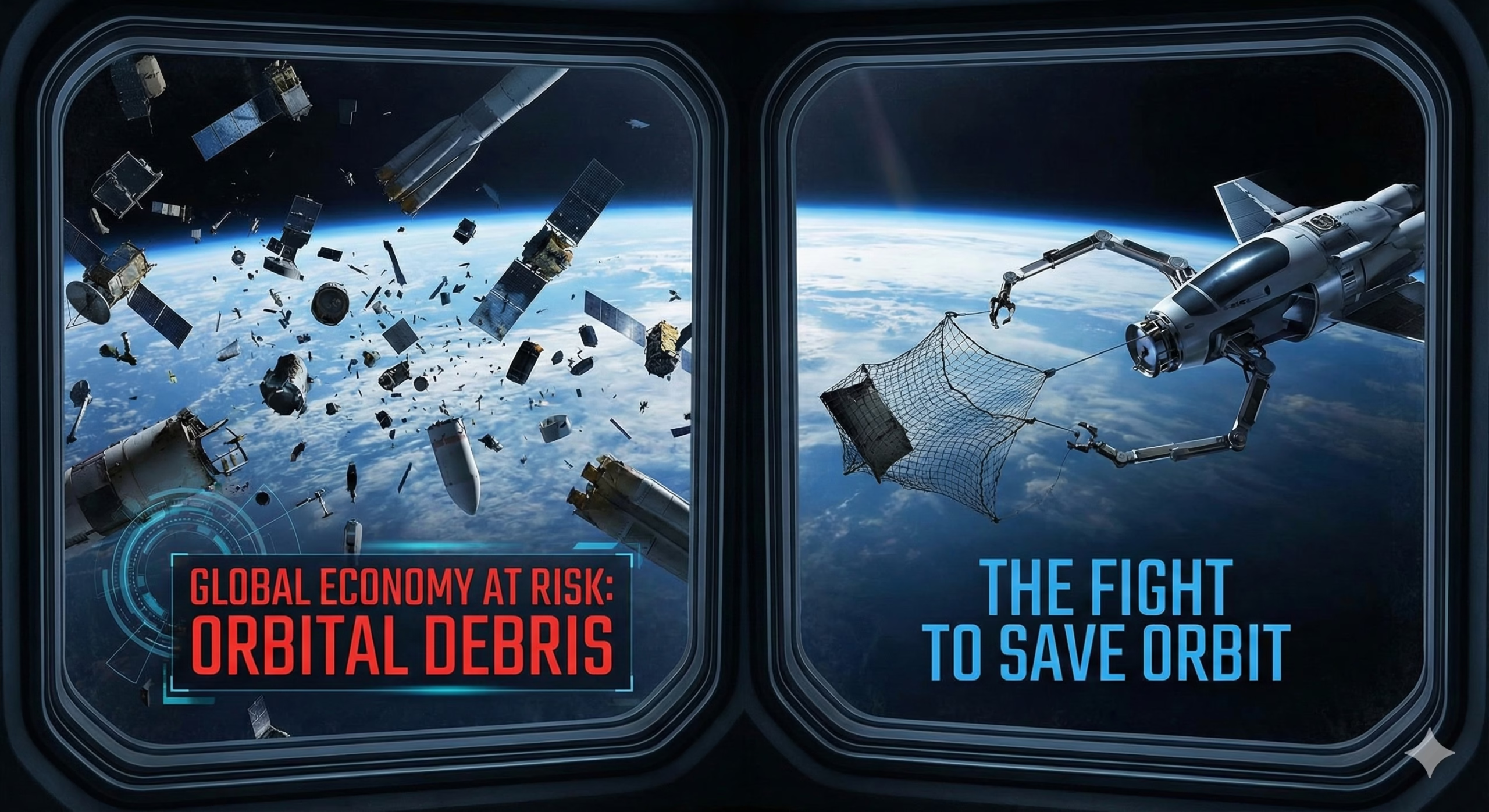
The modern world runs on a critical, yet largely invisible, infrastructure orbiting hundreds of kilometers above our heads. From the GPS navigation on our phones and the daily weather forecasts that guide agriculture and travel, to the global communications that connect economies, our reliance on satellites is profound and growing. This orbital ecosystem is a utility as essential as any terrestrial power grid or water system. But as our activity in space has accelerated, so has a dangerous byproduct: space debris. Mitsunobu Okada, founder of the orbital logistics company Astroscale, has aptly described the result as a “dangerous traffic jam in space.” This ever-increasing congestion has given rise to a theoretical tipping point known as the Kessler Syndrome a cascading chain reaction of collisions that could render Low Earth Orbit (LEO) unusable for generations. This analysis will explore the nature of the Kessler Syndrome, its cascading consequences for the global economy and security, and the innovative technological and policy solutions being developed to secure our future in space.
1. A Planet in Chains: Understanding the Orbital Debris Problem
The orbital debris environment is not a static junkyard but a dynamic and escalating hazard. Understanding the scale, composition, and history of this debris is essential to appreciating the risk it poses. Every defunct satellite, jettisoned rocket stage, and stray fragment from past collisions adds to a complex orbital equation where the probability of catastrophic failure rises daily.
Orbital debris, or “space junk,” is defined as any human-made object in space that no longer serves a useful purpose. This includes everything from decommissioned satellites and upper stages of launch vehicles to fragments from on-orbit explosions and collisions. The sheer volume of this material is staggering:
- Trackable Debris: Current space situational awareness capabilities can track approximately 25,000 pieces of debris larger than 10 centimeters in diameter.
- Lethal but Untrackable Debris: The threat is magnified by an enormous population of smaller, untrackable fragments. Estimates suggest there are over 1 million fragments larger than 1 cm and as many as 130 million pieces of untraceable debris in total.
- Hypervelocity Impacts: In Low Earth Orbit, objects travel at extreme velocities ranging from 7 to 8 kilometers per second. At these speeds, the kinetic energy of a 1-centimeter aluminum sphere is comparable to that of a bowling ball traveling at 100 km/h, making it capable of completely destroying a satellite upon impact.
While debris has accumulated since the dawn of the space age, a few key events have dramatically worsened the environment, acting as force multipliers for orbital pollution. These events serve as stark reminders of the fragility of the orbital commons.
- 2007 Chinese Anti-Satellite (ASAT) Test: In a deliberate test, China destroyed one of its own weather satellites, creating a massive debris cloud of more than 3,000 trackable pieces.
- 2009 Iridium-Cosmos Collision: A defunct Russian Cosmos satellite accidentally collided with a functioning U.S. Iridium commercial satellite, generating over 2,000 pieces of debris and marking the first major collision between intact spacecraft.
- 2021 Russian Anti-Satellite (ASAT) Test: Russia destroyed one of its defunct satellites, creating over 1,500 pieces of debris that forced astronauts aboard the International Space Station (ISS) to take shelter as a precautionary measure.
These events have not only added to the physical clutter but have also proven the central thesis of a theory proposed decades earlier a theory that predicts a catastrophic future for our orbital environment.
2. The Cascade Effect: What is the Kessler Syndrome?
In 1978, NASA scientist Donald Kessler and his colleague Burton Cour-Palais published a seminal paper that fundamentally shifted the perception of orbital space. Their work served as a foundational warning, reframing the vastness above us not as an infinite resource but as a finite, fragile environment susceptible to irreversible pollution. This warning is now famously known as the Kessler Syndrome.
The theory describes a self perpetuating chain reaction. As the density of objects in orbit increases, the probability of collisions rises. When a collision occurs, it generates thousands of new fragments. Each of these fragments, now a projectile, further increases the density and the probability of subsequent collisions. This creates a feedback loop, leading to an exponential growth in debris that could eventually make certain orbits unusable.
In a recent interview, Donald Kessler offered a stark vision of the long-term outcome, warning that this process is now inevitable and self-sustaining. “We’re creating a planet like Saturn and it’s not going to stop,” he stated. “If we live long enough, we’ll see those rings.” His prediction underscores that the debris population has reached a critical density where collisions will continue to generate more debris, regardless of future launch practices.
The scientific consensus is clear: mitigation alone preventing the creation of new debris—is no longer sufficient to stabilize the environment. Multiple studies have concluded that stabilizing Low Earth Orbit requires a dual approach: achieving a 90 percent compliance rate for post-mission disposal guidelines (such as the “25 year rule”) and, critically, actively removing at least five large, defunct spacecraft from orbit every single year. Without active remediation, the cascade effect will continue to accelerate, threatening the very infrastructure upon which our modern world depends.
3. The “Tragedy of the Commons”: Assessing the Global Consequences
The consequences of unchecked orbital debris extend far beyond the space industry, threatening global economic stability, national security, and international equality. The core of the crisis is a classic economic principle known as the “Tragedy of the Commons,” where a shared, unregulated resource is inevitably degraded by rational actors pursuing their own self-interest. In orbit, each satellite operator benefits fully from launching their asset but shares the cost of the increased collision risk with every other operator. This dynamic fuels a cycle of escalating congestion and risk.
The financial impacts of this orbital tragedy are already being felt and are projected to grow exponentially.
- A “Tax” on Space Operations: Debris imposes direct and rising costs on all space activities. Operators must perform constant collision avoidance maneuvers SpaceX, for example, reported conducting 25,299 maneuvers for its Starlink constellation in a single six month period. This drives up operational costs, while the heightened risk of asset loss leads to surging insurance premiums.
- Systemic Risk to Global Infrastructure: The greatest danger lies in the potential loss of critical satellite services. A significant disruption to Global Navigation Satellite Systems (GNSS) would trigger multi-billion-dollar daily impacts across the global economy. Sectors including transportation, energy grids, banking and financial markets, precision agriculture, and emergency healthcare services would face severe disruption.
- Hindering Emerging Space Nations: A congested and high-risk orbital environment creates a formidable barrier to entry for developing nations. Lacking the resources for advanced collision tracking, avoidance maneuvers, and expensive insurance, emerging space powers are effectively locked out of a critical arena for economic and technological development, deepening the gap between established and aspiring spacefaring countries.
Compounding these economic threats are profound legal and liability challenges. The primary international treaty, the Liability Convention, was drafted for a simpler era and is ill-equipped for modern complexities. Its strict liability regime, which holds the launching state responsible, fails to address scenarios involving intervening third parties, such as a satellite being hijacked through cyberwarfare and used to cause harm. This legal ambiguity creates perverse incentives and undermines accountability, leaving the international community without a clear framework for resolving disputes in an increasingly contested domain.
4. The Global Response: A Two Pronged Strategy for Orbital Stewardship
Addressing the orbital debris crisis requires a comprehensive, two-pronged strategy that combines mitigation (preventing the creation of new debris) and remediation (actively removing existing debris). For decades, the focus was almost exclusively on mitigation. However, with the realization that the debris environment has reached a tipping point, a global consensus has emerged that both approaches are now essential for a sustainable future in space.
Mitigation Efforts (Prevention)
Mitigation guidelines aim to ensure that new missions do not add to the long-term debris problem. A key international standard has been the “25 year rule,” which recommends that satellites in LEO be deorbited within 25 years of their mission’s end. However, seeking to accelerate the cleanup, the U.S. Federal Communications Commission (FCC) recently mandated a much stricter “5-year rule” for its licensees.
This move has been met with mixed reactions. Companies like SpaceX, whose satellites are designed for rapid replacement, have strongly supported the rule. In contrast, others like Amazon’s Kuiper have raised concerns about the compliance burdens and operational risks for large constellations still in development. The core challenge remains enforcement and adoption. The global compliance rate for the 25 year rule has historically averaged only 20-30 percent—a figure far below the 90 percent rate that studies show is required to merely slow the growth of new debris.
Remediation Efforts (Active Debris Removal – ADR)
With mitigation alone proving insufficient, Active Debris Removal (ADR) has transitioned from a theoretical concept to a technological necessity. Numerous public and private missions are now underway to develop and demonstrate the capabilities required to capture and deorbit large, defunct objects. These technologies generally fall into two categories:
| Technology Category | Description & Examples |
| Contact-Based Removal | Involves physically capturing debris. Examples include robotic arms (e.g., ESA’s ClearSpace-1 mission, which will use a four-armed robot to capture a defunct rocket part), nets, and harpoons. Astroscale is a leading commercial company developing these on-orbit services, demonstrating capabilities like rendezvous, inspection, and magnetic docking. |
| Contactless Removal | Involves altering a debris object’s orbit without physical touch. Examples include ground-based or space-based lasers that use photon pressure or ablation to gently “nudge” objects into new trajectories. Other proposed concepts include Just-in-Time Collision Avoidance (JCA), which would use rapidly launched sounding rockets to deploy a cloud of particles to brake a debris object just before a predicted collision. |
While these technologies are promising, they are expensive and complex to deploy at scale. More importantly, they do not address the root economic incentives that continue to fuel the tragedy of the commons, pointing to the need for parallel policy innovation.
5. Beyond Technology: Economic Incentives for a Sustainable Orbit
Technological solutions like active debris removal are critical, but they treat the symptoms, not the cause. To correct the underlying market failure that drives the tragedy of the commons in orbit, these technologies must be paired with sound economic policy. Just as carbon taxes are designed to make polluters pay for environmental damage, a similar approach can create powerful incentives for orbital stewardship.
The most promising economic solution proposed is an Orbital Use Fee (OUF). This policy would function much like a carbon tax, requiring satellite operators to pay an annual fee for every satellite they operate in orbit. The fee would be calculated based on the collision risk that the satellite imposes on all other operators, thereby “internalizing the externality.” By putting a direct price on orbital congestion, an OUF would incentivize operators to:
- Launch fewer, more robust satellites.
- Choose orbits that are less congested.
- Deorbit defunct satellites as quickly as possible to stop paying the fee.
A landmark economic study projected that an optimal fee would need to rise over time, reaching approximately $235,000 per satellite-year in 2040. The economic benefit of implementing such a policy would be transformative. The same study concluded that an OUF could more than quadruple the long-run value of the satellite industry, increasing it from a projected 600 billion under a “business-as-usual” scenario to around **3 trillion** by 2040.
This approach is a cornerstone of a broader shift away from a linear “take-make-waste” space economy to a circular economy based on responsible stewardship, reuse, and recycling. By creating a market for on-orbit services like refueling, repair, and end-of-life disposal, we can build a sustainable economic ecosystem in space. A sustainable future in orbit requires a holistic approach where technology and policy work in tandem.
Conclusion: Securing the Final Frontier
The escalating problem of orbital debris and the looming threat of the Kessler Syndrome represent an existential risk to our future in space. For decades, we have treated Earth’s orbit as an infinite resource, but it is a finite commons that is now dangerously close to environmental collapse. Allowing this to happen would not only cripple the global economy but also trap humanity on Earth, surrounded by a self-made cage of high-velocity shrapnel.
The path forward requires a comprehensive strategy that attacks the problem on all fronts: first, by enforcing robust mitigation standards like the 5-year rule to stop the bleeding; second, by aggressively deploying Active Debris Removal technologies to clean the existing wound; and finally, by implementing powerful economic incentives like orbital-use fees to cure the underlying disease that drives the tragedy of the orbital commons.
Securing the orbital commons is not just an industry challenge; it is a global imperative for our generation and those to come. As Mitsunobu Okada rightly states, “The future of space depends on it.”
Discover more from Pasindu Lakshan Perera
Subscribe to get the latest posts sent to your email.

Related Posts

The “Ant” Exodus: Deconstructing South Korea’s Retail Investment Crisis and the Macroeconomic Fallout
Analyzing the Exponential Rise of the Indian Space Ecosystem