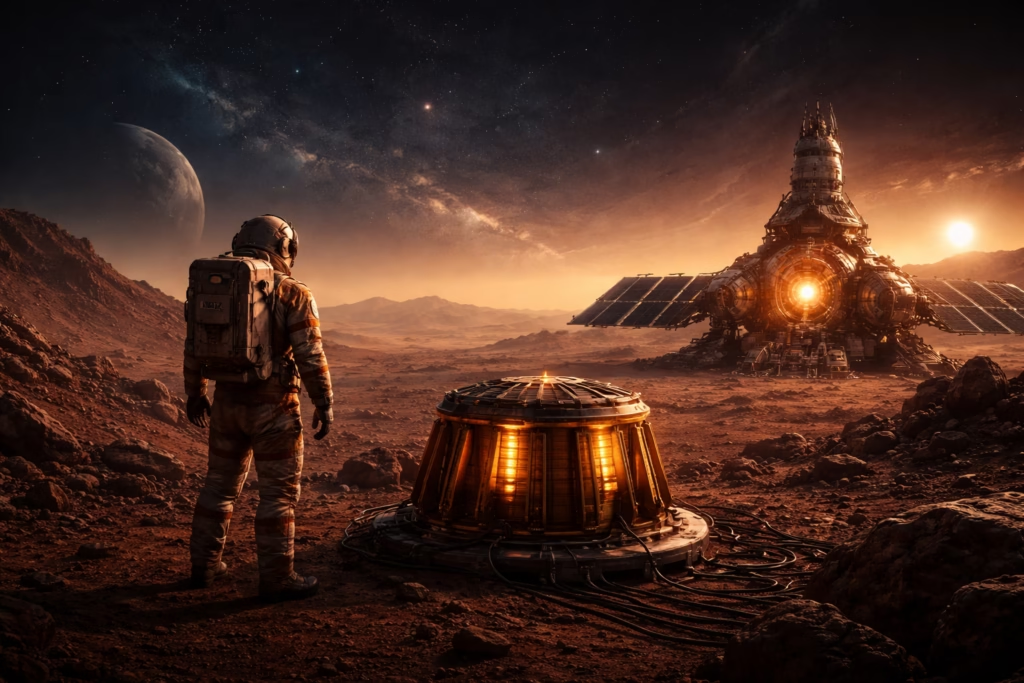
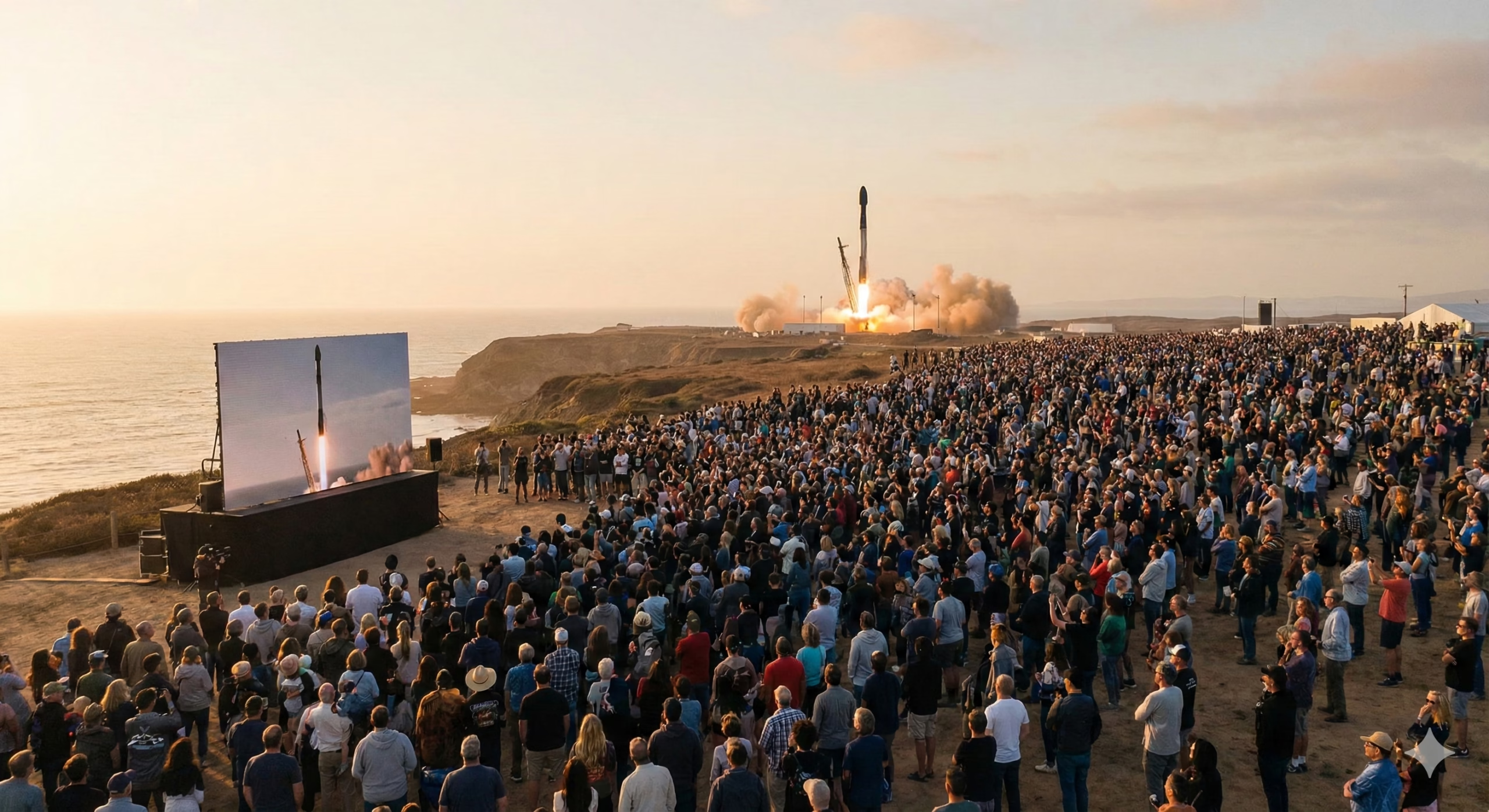
Rocket Lab’s evolution represents a modern space odyssey, a narrative of a company that has executed a masterful transformation from a disruptive launch provider into a formidable, vertically integrated space corporation. This journey began with audacious dreams in a modest New Zealand workshop and has expanded to encompass the entire space value chain. The story is marked by a series of calculated strategic maneuvers: the creation of the groundbreaking Electron rocket, which industrialized access to orbit for small satellites; a decisive pivot to building entire space systems to capture upstream market value; audacious interplanetary missions that serve as technical demonstrations of force; and the development of the next-generation Neutron rocket, poised to challenge incumbents in the medium-lift market. This is the story of how a Kiwi upstart became an indispensable powerhouse in the global space economy.
1. The Genesis: Forging a New Path from the Edge of the World
Rocket Lab’s origin story is rooted in founder Peter Beck’s strategic “first principles” approach. In a deliberate break from industry convention, Beck assembled a team of hands on builders mechanical engineers, electronics specialists, and composites experts who possessed no prior space pedigree. He correctly theorized that starting without the predetermined methods of the established aerospace industry would foster radical innovation and allow the company to rethink every aspect of space access from the ground up.
Founded by Beck, the company was driven by a clear vision: to revolutionize access to space for the burgeoning small satellite market. This entrepreneurial spirit was combined with audacious dreams and inspiring leadership, setting the stage for a new era of commercial spaceflight.
This vision was first validated with the successful launch of the Ātea-1 rocket in 2009. This slender, six-meter suborbital vehicle, built from carbon composites, reached an altitude of roughly 120 km, crossing the edge of space. The achievement made Rocket Lab the first private company in the Southern Hemisphere to reach space. More importantly, it proved that orbital-class engineering could emerge from a “modest workshop at the edge of the world,” establishing the company’s credibility and earning it true respect within the industry.
These early suborbital achievements laid the critical groundwork for the company’s next great endeavor: the development of its game changing orbital rocket, Electron.
2. The Workhorse: How the Electron Rocket Democratized Space
Electron was not merely an engineering feat; it was a market-defining move. By deliberately targeting the underserved small satellite sector a niche long ignored by legacy launch providers focused on larger payloads Rocket Lab created and dominated a new market segment, effectively industrializing access to orbit. This opened the door for a new generation of commercial constellations, government agencies, and research institutions that previously lacked a viable path to space, turning complex orbital access into an expected, industrial-scale delivery service.
Electron’s success is built on a foundation of key technical innovations that set it apart from its predecessors and competitors.
- Rutherford Engine: The rocket is powered by the world’s first 3D printed, electric pump fed orbital engine. Using electric motors and batteries to power the pumps instead of traditional gas generators resulted in a less complex design with fewer moving parts. The extensive use of additive manufacturing allows for the primary components of an engine to be printed in just 24 hours, enabling dramatically faster production.
- Carbon-Composite Structure: Electron was the world’s first fully carbon-composite launch vehicle. This lightweight but strong material is critical to achieving the performance needed to deliver payloads to orbit with a small rocket.
- Payload Capacity: Continuous improvements have increased the rocket’s capability, allowing it to carry up to 320 kg to Low Earth Orbit (LEO) and 200 kg to a Sun-Synchronous Orbit (SSO).
Electron has established itself as the world’s most frequently launched small lift orbital rocket. In 2025 alone, the company set a new annual record with 21 launches, all achieving 100% mission success. By the end of that year, Electron had completed 79 launches in total. This high cadence and proven reliability have attracted a diverse customer base, including commercial constellation operators like Capella Space and iQPS, civil agencies such as NASA, and a wide array of U.S. defense and intelligence clients, including the National Reconnaissance Office (NRO), DARPA, and the U.S. Space Force.
The Pursuit of Reusability
Although not part of its original design, Rocket Lab initiated a program to recover and reuse Electron’s first stage. This strategic shift was driven by the need to meet increasing launch demands and further reduce costs. The recovery method is as innovative as the rocket itself, involving a guided atmospheric reentry of the booster, deployment of a parachute, and a planned mid-air capture by a helicopter equipped with a long-line hook.
Having mastered the art of launch, Rocket Lab turned its attention to a new strategic frontier: building the satellites that its rockets carry to orbit.
3. Beyond Launch: The Strategic Pivot to an End-to-End Space Company
Recognizing that the launch sector is a high-volume, low-margin business vulnerable to commoditization, Rocket Lab executed a deliberate pivot to vertical integration. This was a two-pronged strategic imperative: first, to insulate its launch manifest from supply chain vulnerabilities, and second, to capture the far more lucrative upstream revenue in the space systems market, thereby building a defensible economic moat around its entire operation. The core of this strategy has been aggressive vertical integration, bringing critical supply chain elements in-house.
This philosophy is best captured in the words of founder and CEO Peter Beck:
“If the supply chain can not provide us the surety to deliver what we need, then we’ll go and vertically integrate”
“If it’s too expensive and it’s too slow, generally we need to own it because we can make it cheaper and faster”
Building the Space Systems Portfolio
Through a series of strategic acquisitions, Rocket Lab has assembled a formidable portfolio of space systems capabilities, giving it control over nearly every aspect of spacecraft design and manufacturing.
- Satellite Components:
- Sinclair Interplanetary: Brought in-house the production of high quality reaction wheels and star trackers, essential components for satellite attitude control.
- Solaero: Added the capability to manufacture space-grade solar panels, making Rocket Lab one of only three such suppliers in the world and securing a critical component for spacecraft power.
- Spacecraft Systems & Software:
- Advanced Solutions, Inc (ASI): Provided expertise in space guidance, navigation, and control (GNC) software, a cornerstone of spacecraft operation.
- Planetary Systems Corporation (PSC): Integrated flight-proven separation systems and payload adapters, ensuring reliable satellite deployment.
- Advanced Capabilities:
- GEOST: Added sophisticated space domain awareness and optical payload systems, strengthening the company’s offering for high-value national security missions.
- Mynaric: Rocket Lab is advancing the acquisition of Mynaric, a German manufacturer of optical communication terminals. Once finalized, this deal will bring in-house the technology for secure, high-speed inter-satellite laser links.
This vertical integration has fundamentally reshaped the company’s business model. It has created a powerful dual revenue stream where the Space Systems segment has become the primary growth driver, accounting for 73.61% of the company’s record $155 million in revenue in Q3 2025.
This vertically integrated machine was not merely a business strategy; it became the engine for profound technical achievement. With in house control over everything from star trackers to solar panels and propulsion, Rocket Lab could now design, build, and fly highly complex interplanetary missions like CAPSTONE and ESCAPADE with a speed and cost-efficiency previously unthinkable in planetary science.
4. Pushing the Frontiers: Rocket Lab’s Interplanetary Ambitions
Rocket Lab’s interplanetary missions are more than just technical achievements; they are powerful demonstrations of a new paradigm in planetary science. By leveraging its low cost Electron rocket and highly capable Photon spacecraft, the company is proving that high performance deep space exploration can be achieved at a fraction of traditional costs. These missions showcase the full power of its end-to-end space systems, enabling a higher cadence of scientific discovery and expanding opportunities for the entire research community.
- CAPSTONE: A Pathfinder to the Moon For NASA’s CAPSTONE mission, Rocket Lab provided a complete end-to-end solution. An Electron rocket first launched the CAPSTONE CubeSat to low Earth orbit. From there, Rocket Lab’s Lunar Photon spacecraft took over, performing a series of orbit-raising burns before successfully deploying the satellite on its ballistic lunar transfer trajectory. The mission was a crucial pathfinder for NASA’s Artemis program, testing the unique Near Rectilinear Halo Orbit (NRHO) intended for the future Gateway lunar outpost.
- ESCAPADE: A Coordinated Mission to Mars The ESCAPADE mission, also for NASA, involves twin spacecraft, dubbed “Blue” and “Gold,” built on Rocket Lab’s versatile Photon platform. Their objective is to orbit Mars and study its magnetosphere, providing the first-ever simultaneous two-point observations of how the planet’s magnetic field interacts with the solar wind. This coordinated mission will reveal Mars’s real-time response to space weather. Following their launch, the spacecraft are planned to arrive at the Red Planet in September 2027.
- A Private Quest for Life on Venus In one of its most audacious projects, Rocket Lab is funding a private mission to search for signs of life in the clouds of Venus. The mission involves sending a small (~20 kg) direct entry probe, launched by an Electron and delivered by a Photon, into the Venusian atmosphere. The probe is designed to spend approximately 5 minutes descending through the cloud layers at an altitude of 48–60 km, using an autofluorescing nephelometer to search for the presence of organic molecules. The mission had a baseline launch window of May 2023 with a backup opportunity in January 2025.
To support not only these ambitious missions but also the deployment of large satellite mega-constellations, Rocket Lab recognized the need for a larger, more powerful rocket.
5. The Next Giant Leap: Neutron and the Future of Medium-Lift
The Neutron rocket is Rocket Lab’s strategic answer to the growing market demand for mega constellation deployment, deep-space exploration, and high-assurance national security missions. Positioned to compete in the medium lift class, Neutron is the key to unlocking the full potential of the company’s vertically integrated business model. It is designed from the ground up for reliability, reusability, and cost-effectiveness, aiming to advance the state of the art in launch vehicle technology. Critically, Neutron is also the key to unlocking Rocket Lab’s own constellation-scale ambitions, providing the launch capacity necessary to deploy the very satellite systems its other divisions are building, creating a powerful, self-reinforcing business cycle.
| Feature | Description |
| Class | Medium-lift, reusable launch vehicle. |
| Structure | Carbon composite. |
| Payload Capacity | Up to 15,000 kg (33,000 lbs) to Low Earth Orbit (expendable). The reusable configuration is designed to deliver a 17,600 lb (8,000 kg) payload. |
| Engine | Powered by the Archimedes engine, using an oxygen-rich staged combustion cycle. |
| Reusability | Designed for rapid reuse with a ‘pop-top’ integrated fairing that remains attached to the first stage. Capable of both return-to-launch-site landings and landings at sea on its autonomous platform, named ‘Return On Investment’. |
| Fairing | Features an innovative integrated fairing that remains attached to the first stage, simplifying recovery operations and reducing refurbishment costs. |
| Launch Site | Will launch from a new pad at the Mid-Atlantic Regional Spaceport in Virginia, USA. |
The development timeline for Neutron has been adjusted to ensure a successful debut. After an initial target of 2024, the first launch was moved to the second half of 2025 and subsequently delayed to 2026. This deliberate pace reflects the company’s commitment to thorough ground testing. As CEO Peter Beck stated, the focus is on getting it right: “Neutron will fly when we’re very confident it’s ready and we’re not going to break the mold of the Rocket Lab magic.”
This methodical development is heavily supported by crucial partnerships with the U.S. government, validating Neutron’s design and paving the way for its role in national security.
6. An Indispensable Partner: Cementing a Role in National Security
Rocket Lab has systematically cultivated its position to become a trusted and essential partner for U.S. national security space missions. This strategic success is built on the powerful combination of responsive launch capabilities from U.S. soil, a secure and vertically integrated supply chain, and advanced satellite manufacturing. The company’s ability to deliver reliable, rapid access to space has solidified its importance to the U.S. Department of Defense and the intelligence community.
This deep integration is evidenced by a series of high-value government and defense contracts.
- Space Development Agency (SDA): Rocket Lab secured a landmark $816 million prime contract to design, build, and operate 18 Tranche 3 missile-tracking satellites.
- U.S. Space Force (USSF): The company was awarded a $24.35 million contract for the development of Neutron’s high-performance upper stage. This contract is a critical step to on-ramp the Neutron vehicle into the National Security Space Launch (NSSL) program, which handles the nation’s most sensitive payloads.
- National Reconnaissance Office (NRO): Rocket Lab is a proven launch provider for the NRO, having successfully launched multiple classified intelligence-gathering satellites.
- Hypersonic Accelerator Suborbital Test Electron (HASTE): A strategic adaptation of the Electron platform to serve the high-demand hypersonic testing market, providing a dedicated suborbital testbed for customers like the Missile Defense Agency.
A key piece of this strategy is Launch Complex 2 (LC-2), Rocket Lab’s launch site at the Mid-Atlantic Regional Spaceport in Virginia. Purpose built for the U.S. government, LC-2 is optimized for responsive access to space, capable of supporting up to 12 missions per year and processing two Electron rockets simultaneously for launch within 24 hours.
This deep and growing partnership with the defense sector provides a stable foundation of long-term revenue and validates Rocket Lab’s position as a key pillar of the U.S. space industrial base.
Conclusion: An Odyssey Continues
Rocket Lab’s journey from a niche small-satellite launch provider to a comprehensive, end to end space company is a testament to its unique blend of audacious innovation, relentless execution, and masterful strategy. Its success was forged with the Electron rocket, a vehicle that fundamentally changed the economics of space access. That foundation of launch excellence enabled a brilliant pivot into satellite manufacturing through disciplined vertical integration, giving the company unparalleled control over its destiny. Now, with deep-space missions to its credit and the powerful Neutron rocket on the horizon, Rocket Lab has firmly established itself as a critical player in the global space economy. While Electron established its market dominance and Neutron prepares to challenge the medium-lift incumbents, it is the seamless integration of its launch and space systems divisions that positions Rocket Lab not just as a competitor, but as one of the few emerging, indispensable pillars of the Western space industrial base.
Discover more from Pasindu Lakshan Perera
Subscribe to get the latest posts sent to your email.

Related Posts

The “Ant” Exodus: Deconstructing South Korea’s Retail Investment Crisis and the Macroeconomic Fallout

Analyzing the Exponential Rise of the Indian Space Ecosystem