
Introduction
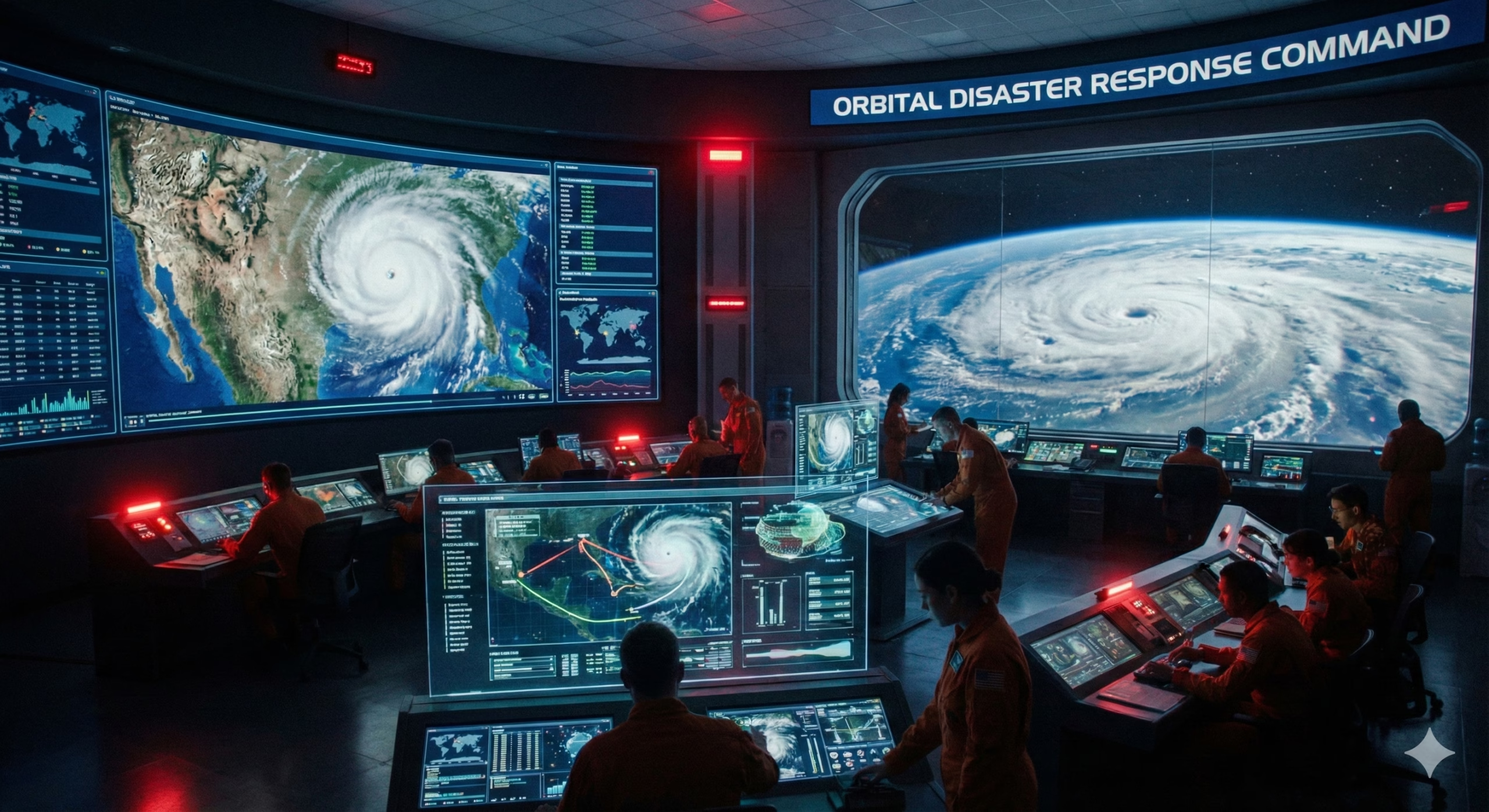
As the global community faces an increasing frequency and intensity of natural disasters, our ability to prepare, respond, and recover is being tested as never before. Against this backdrop of growing risk, a quiet revolution is taking place hundreds of kilometers above our heads. The next decade is poised to witness a paradigm shift in how we manage catastrophic events, a transformation driven not by earthbound solutions, but by an increasingly sophisticated network of advanced space based systems. This new era of planetary stewardship will be built upon the twin pillars of Earth Observation satellites and Global Navigation Satellite Systems, technologies that are evolving from passive instruments into dynamic, predictive tools for global resilience.
1. The View from Above: Earth Observation as Our First Line of Defense
For decades, Earth Observation (EO) satellites have provided a passive, yet invaluable, “view from above.” This steady stream of imagery has chronicled the changes on our planet’s surface, from shifting coastlines to urban expansion. Now, this capability is evolving into something far more dynamic. We are moving beyond simply documenting disasters after they occur and are entering an era where EO data provides the intelligence to anticipate, monitor, and mitigate their impact in near real time. This strategic shift from reactive recovery to proactive resilience is fundamentally changing the field of disaster management.
Mapping the Inundation
When floods devastate a region, the first and most critical need for emergency services is a clear understanding of the disaster’s scale. During the heavy rainfall and widespread flooding in Australia’s Gippsland region in 2007, this is precisely the role that EO data played. By comparing Landsat satellite images taken two weeks before the rains with images captured at the flood’s peak, authorities at Geoscience Australia could precisely map the extent of the inundation. This vital situational awareness was provided to emergency services, enabling them to direct resources effectively, save lives, and mitigate further economic impact.
Securing Global Food Supplies
Food security is a cornerstone of global stability, and it is increasingly under threat from extreme weather events like droughts. EO programs like Europe’s Copernicus and the US’s Landsat provide the data necessary to monitor agricultural health on a global scale. In the Marchfeld region of Lower Austria, for instance, EO data is used to develop services that assess crop water requirements, allowing farmers to optimize irrigation schedules. An assessment of the service revealed that 50% of farmers believed further improvements could be achieved by optimizing water use based on this data. This level of precision farming not only increases yield but provides an early warning system for potential droughts, allowing governments to take preemptive action to prevent food security crises.
Guarding Marine Ecosystems
The threats are not limited to land. Along coastlines, Harmful Algal Blooms (HABs) can decimate aquaculture industries. The ASIMUTH project was established to provide short-term forecasts of these events along Europe’s Atlantic coasts. By integrating EO data into advanced models, the project delivers critical warnings to the fishing and shellfish industries, allowing operators to take mitigating actions. The return on this investment is tangible: analysis shows that if these forecasts help recoup just 12.5% of losses for the mussel industry, the potential savings would be approximately $2.59 million. This demonstrates a clear economic case for using space-based assets to protect marine ecosystems and the livelihoods that depend on them.
The power of these applications has been dramatically amplified by the “open data” paradigm shift. Pioneered by programs like the US Landsat mission in 2008 and followed by the European Copernicus programme, the policy of making vast archives of satellite imagery available to the public free of charge has been a watershed moment. This spurred innovation in the downstream sector, where companies create Value Added Services (VAS) that translate raw data into actionable intelligence. However, this deluge of freely available data creates a new strategic challenge: how to process and analyze petabytes of information at a global scale. While EO provides the broad view, mastering this data torrent and integrating it with other high-precision systems is what unlocks its full potential.
2. Pinpoint Accuracy: The Unseen Power of Real-Time Positional Data
While Earth Observation provides the broad view, another constellation of satellites offers something equally critical: pinpoint accuracy. Global Navigation Satellite Systems (GNSS) have evolved far beyond their common use in smartphone maps. As the UK Space Agency notes, high-precision Positioning, Navigation, and Timing (PNT) are no longer mere enablers of modern life but have become “critical components of national resilience.” This unseen utility provides the ultra-precise, real-time positional data necessary to detect the subtle movements of the Earth’s crust that precede earthquakes and tsunamis.
A powerful case study of this capability comes from Italy’s Rete Integrata Nazionale GNSS (RING) network. Managed by the National Institute of Geophysics and Volcanology, this network of ground-based receivers is demonstrating how real-time GNSS data can form the backbone of a next-generation early warning system.
- The Technology: The RING network leverages signals from multiple GNSS constellations including GPS (USA), GLONASS (Russia), Galileo (EU), and BeiDou (China) to achieve exceptionally high precision positioning across the Italian peninsula.
- The Performance: In real-time analysis, the system achieves average accuracies of 2.05 cm for the North component, 1.73 cm for the East component, and 4.35 cm for the vertical component a level of precision that can detect minute ground shifts.
- The Speed: Critically for early warning, the system is incredibly fast. Analysis shows that 87% of the network’s stations achieve this centimeter-level accuracy in under five minutes after initializing.
The combination of this speed and accuracy is transformative. For disasters like earthquakes and tsunamis, where every second counts, the ability to detect ground displacement almost instantaneously is the key to creating effective Tsunami Early Warning (TEW) and Earthquake Early Warning (EEW) systems. The RING network proves that the technology to provide these life-saving alerts is not a future concept but a current, operational reality. These powerful capabilities are now being scaled globally, driven by technological and economic forces that are reshaping the entire space sector.
3. The Accelerants: The Forces Shaping the Next Generation of Space Based Systems
While the power of EO and GNSS technology is clear, two parallel revolutions one in how we access data and the other in how we access space itself are set to exponentially accelerate their deployment and impact over the coming decade. These forces are fundamentally altering the economics and logistics of space-based systems, making them more powerful, more accessible, and more integrated into our daily lives.
The Data Access Revolution
Historically, working with satellite data meant downloading massive, cumbersome files to local machines for processing. Today, that model is being replaced by a far more efficient, cloud based approach. The market is shifting from users downloading raw data to interacting with it on powerful online platforms. This has given rise to new business models like Data as a Service (DaaS) and Platform as a Service (PaaS). In this new paradigm, users gain access not just to the EO data itself but also to the vast computing resources, processing tools, and analytical software needed to work with it, all within a single virtual environment. This removes significant technical and financial barriers, allowing a much wider range of users to develop applications and derive insights from space-based data.
The Space Access Revolution
The second revolution is happening on the launchpad. The advent of reusable launch systems is fundamentally rewriting the economics of getting to orbit. SpaceX’s Starship, for example, is designed with full reusability in mind, enabling a drastic reduction in launch costs and a massive increase in payload capacity. This changes the calculus for deploying space infrastructure.
- Drastic Cost Reduction: The target cost for delivering cargo to low Earth orbit is projected to fall to below $1,000 per kilogram immediately, dropping to below $100 per kilogram within two to three years.
- Massive Payload Capacity: With in-orbit refueling, a single Starship is designed to place 100 metric tons of payload anywhere in the solar system, enabling the deployment of large, sophisticated constellations of satellites in a single launch.
These two revolutions have a profoundly symbiotic relationship. Cheaper launch enables more powerful constellations that generate unprecedented data volumes; cloud platforms are the only viable solution to process this torrent of information and turn it into actionable intelligence. One revolution is ineffective without the other. This synergy between hardware in orbit and software on the ground requires a strategic vision and international cooperation to fully harness its potential.
4. A Global Imperative: Forging a Resilient Future from Orbit
Leveraging space technology for disaster management is no longer just a scientific endeavor; it has become a core strategic priority for national governments and international bodies. In an interconnected world, a disaster in one region can have cascading effects on global supply chains, economies, and security. Investing in space-based systems is therefore an essential investment in global resilience and economic stability.
This strategic commitment is evident across the world’s leading space-faring entities.
- NASA’s “Decadal Survey” for Earth science provides a long-term strategic framework, prioritizing science targets and observation requirements to guide U.S. investments for the decade ahead.
- The European Union’s Copernicus programme, with an investment of EUR 7.4 billion, is a testament to the continent’s commitment to using EO for public services and generating tangible economic value.
- The UK Space Agency has explicitly identified capabilities like Positioning, Navigation, and Timing (PNT) as foundational to securing national resilience in an increasingly data-driven world.
A critical pathway for turning these strategic investments into public benefit is the “research to operations” (R2O) pipeline. As outlined in the Decadal Survey, research-focused agencies like NASA make foundational investments in new technologies, raising their Technology Readiness Level (TRL). This de-risks the technology, allowing operational agencies like the National Oceanic and Atmospheric Administration (NOAA) and the U.S. Geological Survey (USGS) to adopt these innovations more efficiently, directly improving the public services they deliver, from weather forecasts to geological hazard monitoring.
We are at the dawn of a new age in planetary management. The convergence of advanced Earth Observation, hyper-precise navigation systems, radically cheaper access to space, and scalable cloud computing is creating a powerful global infrastructure for disaster management. This fusion of technologies marks a fundamental shift from reactive monitoring to proactive, predictive mitigation. In the coming years, these celestial sentinels will stand guard over our planet, providing the foresight and insight needed to protect communities, secure economies, and forge a safer, more resilient future for all.
Discover more from Pasindu Lakshan Perera
Subscribe to get the latest posts sent to your email.

Related Posts

Analyzing the Exponential Rise of the Indian Space Ecosystem

Navigating the Strategic Challenges of NASA’s Nuclear Future