
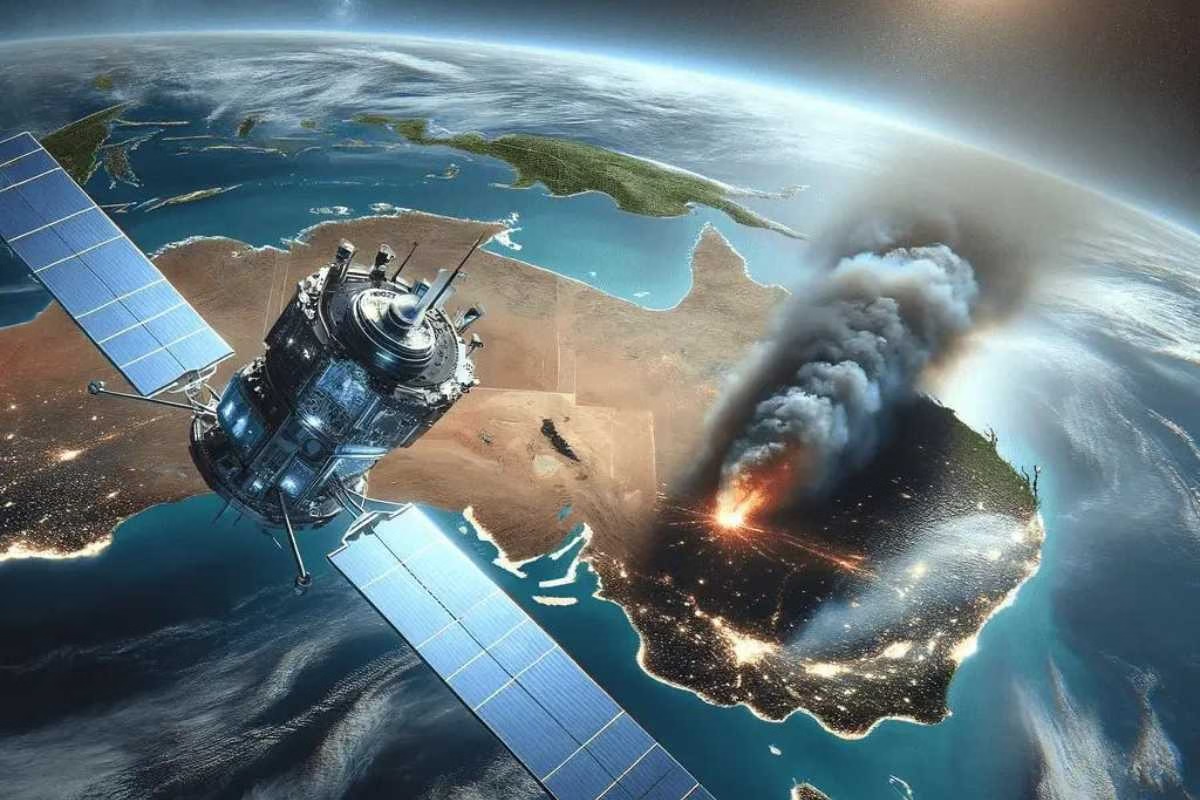
Introduction: Defining the Scope of Space Safety
Space Disaster Management is a critical and multifaceted field essential for the sustainable use of outer space. As human activity beyond Earth’s atmosphere accelerates, the strategies to ensure safety and mitigate potential catastrophes have become paramount. This discipline extends far beyond the commonly known issue of space debris to encompass the complex realities of in-flight launch failures, the protocols for emergency response, and even planetary defense against natural threats like Near-Earth Objects (NEOs). Ensuring safety in this unique environment requires a layered approach, combining proactive prevention with reactive technologies and robust international cooperation.
This guide provides a comprehensive overview of the primary types of space disasters, the current strategies for their management and mitigation, and the future challenges that must be overcome to ensure lasting safety in the final frontier.
——————————————————————————–
1. The Crowded Skies: Understanding the Space Debris Challenge
Nearly five decades of space activity have transformed the near-Earth environment into a hazardous orbital commons. The escalating population of non-functional, human-made objects, collectively known as space debris, poses a significant threat to operational satellites and future missions. Understanding the sheer scale of this problem is the first step in managing the risks it presents.
An analysis of the orbital population, based on data from the European Space Agency (ESA), reveals the scale of the challenge:
- Over 4,800 launches have placed approximately 5,000 satellites into orbit.
- Of these, only about 1,000 satellites remain operational.
- The US Space Surveillance Network actively tracks over 16,000 objects larger than 5-10 cm in Low-Earth Orbit (LEO).
- This catalogued population is composed of 6% operational spacecraft, 28% decommissioned satellites and mission-related objects (like spent upper stages and lens covers), and a staggering 66% resulting from over 200 on-orbit fragmentations.
- Beyond what can be tracked, models estimate there are around 700,000 objects larger than 1 cm orbiting Earth.
The primary danger from this debris is not its size but its velocity. With impact speeds reaching up to 15 km/s in LEO, even a small fragment possesses immense destructive energy. The 2009 collision between the active Iridium-33 satellite and the decommissioned Cosmos-2251 satellite stands as the most prominent of four recorded collisions, an event that created thousands of new debris fragments.
Simulations by both ESA and NASA have shown that the debris population in LEO has reached a “critical density.” This means that the environment is now self-perpetuating; the number of debris objects will continue to grow from collisions between existing objects, creating a potential chain reaction even if no new objects are ever launched. This sobering reality proves that passive observation is no longer sufficient; active measures are now essential to prevent the situation from escalating.
2. The First Line of Defense: International Guidelines for Debris Mitigation
The most effective way to manage any disaster is to prevent it from happening in the first place. Recognizing this, the international community, through the United Nations Committee on the Peaceful Uses of Outer Space (COPUOS), developed the Space Debris Mitigation Guidelines. These guidelines represent the foremost international effort to promote responsible behavior in space and prevent the creation of new debris, forming the foundation of modern space safety policy.
The seven core guidelines, while voluntary, establish a clear framework for space-faring nations and organizations to follow:
- Guideline 1: Limit debris released during normal operations. This encourages designing space systems that do not jettison objects like lens caps or adapters during their mission.
- Guideline 2: Minimize the potential for break-ups during operational phases. This aims to prevent system malfunctions, such as propulsion or power system failures, that could lead to catastrophic fragmentation.
- Guideline 3: Limit the probability of accidental collisions in orbit. This promotes mission planning that includes collision risk assessment and avoidance maneuvers if a potential impact is identified.
- Guideline 4: Avoid intentional destruction and other harmful activities. This discourages activities that generate long-lived debris, such as anti-satellite weapon tests, and stipulates that any necessary break-ups occur at low altitudes where fragments will de-orbit quickly.
- Guideline 5: Minimize post-mission break-ups from stored energy (passivation). This requires depleting all on-board energy sources, such as residual fuel and batteries, at the end of a mission to prevent accidental explosions.
- Guideline 6: Limit the long-term presence of spacecraft in Low-Earth Orbit (LEO) post-mission. This guideline recommends that spacecraft in LEO be removed from orbit, preferably in a controlled manner, after their mission is complete.
- Guideline 7: Limit long-term interference in the Geosynchronous Earth Orbit (GEO) region post-mission. This calls for moving satellites in the valuable GEO region to a higher “graveyard” orbit at the end of their life to prevent interference with operational satellites.
Crucially, these guidelines are not legally binding. They rely on implementation by individual member states through their own national mechanisms and regulations. While they provide a vital framework for managing future debris, a different set of strategies is required to address the thousands of tons of debris already circling our planet.
3. Cleaning Up the Cosmos: The Technology of Active Debris Removal (ADR)
With the orbital environment already at a critical density, mitigation alone is no longer sufficient. Studies by NASA and ESA have concluded that the LEO environment can only be stabilized by actively removing 5 to 10 large objects per year. This necessity has spurred the development of Active Debris Removal (ADR) technologies, a field focused on capturing and de-orbiting existing, high-risk debris.
The selection of ADR targets is strategic, focusing on objects that pose the greatest threat. Key criteria include:
- High Mass: Larger objects create more fragments if they collide.
- High Collision Probability: Targets in densely populated orbital regions are prioritized.
- High Altitude: Debris at higher altitudes has a much longer orbital lifetime, posing a threat for centuries or millennia.
Several innovative capture methods are under development, each with its own approach to wrangling uncooperative, non-functional objects in orbit.
‘Pulling’ Technologies
One of the most promising concepts, known as ‘pulling,’ involves capturing a target with a device like a net or harpoon and then using an attached tether to drag it into a disposal orbit. This method is highly advantageous as it is largely unaffected by a target’s specific shape or spin rate. The European Space Agency is actively studying two primary capture mechanisms for this approach:
- Throw-Nets: A net is ejected from a chaser spacecraft and, driven by masses at its corners, opens to envelop the target. The net entangles the object, allowing the chaser to pull it via an attached tether.
- Harpoons: As an alternative, a harpoon could be fired into the target to secure a connection point for the tether.
‘Pushing’ Technologies
An alternative to pulling is to use a rigid system to capture and then “push” the debris into a de-orbit trajectory. This strategy involves a more complex rendezvous and docking phase. Concepts under study include using a robotic arm combined with “tentacles” to securely clamp onto the target before initiating the de-orbit burn.
Contactless Technologies
The most futuristic approach involves moving debris without any physical contact, thereby avoiding the immense risks of docking with a tumbling object. The leading concept is the “ion-beam shepherd.” In this scenario, a chaser satellite would rendezvous with a debris object and fire a beam of ions at it from a safe distance. The momentum transferred by the ion beam would gradually exert force on the target, slowly pushing it into a new, safer orbit.
Despite these promising technologies, ADR faces significant technical, legal, and financial challenges. Docking with an uncooperative, tumbling satellite has never been achieved without human astronauts. Furthermore, the complexity of multi-target missions and the fundamental questions of who pays for cleanup and how to make it affordable remain major hurdles. These efforts to manage the passive risks within the orbital environment are critical, yet they represent only one facet of the discipline. The active process of spaceflight itself, from launch to operation, presents an entirely different, and equally urgent, set of disaster management challenges.
4. Anatomy of a Failure: Managing In-Flight Space Disasters
The focus of space disaster management must also extend to the inherent risks of launch and flight operations themselves. In-flight anomalies, human error, and organizational oversights can lead to catastrophic failures. The National Transportation Safety Board’s (NTSB) investigation into the 2014 in-flight breakup of SpaceShipTwo provides a powerful case study on the critical roles of human factors, organizational safety culture, and emergency response.
The NTSB determined that the probable cause of the accident was not merely pilot error, but Scaled Composites’ “failure to consider and protect against the possibility that a single human error could result in a catastrophic hazard.” The copilot prematurely unlocked the vehicle’s “feather” system, which was designed for reentry, during the high-stress boost phase of flight. This single action led to aerodynamic overload and the vehicle’s structural failure.
The investigation identified several key factors that contributed to the copilot’s action, highlighting the intense pressures of dynamic flight:
- High Workload: The boost phase required pilots to recall and execute multiple tasks from memory in a very short time.
- Time Pressure: The feather system needed to be unlocked within a narrow window of time, creating anxiety to complete the task and avoid aborting the flight.
- Environmental Stressors: The copilot was subjected to intense vibration and G-loads that he had not recently experienced and which were not replicated in the simulator, likely increasing his stress and workload.
The NTSB also cited significant organizational failures. Scaled’s systems safety analysis was found to be inadequate because it did not account for this type of human error. It relied solely on training as a mitigation strategy, which is considered the lowest and least effective level of defense in system safety design. In effect, Scaled’s safety culture abdicated its engineering responsibility, placing the entire burden of mitigating a catastrophic, single-point failure onto the flawless performance of a human operator in a high-stress environment.
Finally, the investigation touched upon the emergency response on the ground. The NTSB found that the delayed arrival of helicopters to the injured pilot highlighted a need for improved emergency response planning and better utilization of available assets. This case underscores that a comprehensive safety culture must account for the complex interplay between human and machine. It is a lesson that extends beyond engineered systems, informing how we must also prepare for catastrophic events originating not from human error, but from natural threats in the cosmos.
5. Planetary Defense: A Framework for Natural Space Threats
A unique and critical aspect of space disaster management is planetary defense—the effort to detect, track, and prepare for the potential impact of a Near-Earth Object (NEO) on Earth. While the probability of a major impact in any given year is low, the consequences would be catastrophic, making preparedness a global imperative. In the United States, a clear framework has been established to coordinate the government’s response to such a threat.
The Planetary Impact Emergency Response Working Group (PIERWG) serves as the U.S. government’s primary forum for preparing for a NEO impact event. This partnership between the Federal Emergency Management Agency (FEMA) and the National Aeronautics and Space Administration (NASA) delineates clear roles and responsibilities.
NASA’s Role: Detect and Characterize
NASA is the lead U.S. government agency for coordinating the detection, tracking, and characterization of NEOs. Working with domestic and international astronomical organizations, NASA’s role is to analyze an object’s trajectory and physical properties to determine if it represents a credible threat to people or property. Notification procedures are only set in motion after rigorous observation and analysis confirm the danger.
FEMA’s Role: Prepare and Respond
Once NASA notifies FEMA of a credible impact threat, FEMA takes the lead on domestic emergency preparedness and response. FEMA’s primary responsibility is to notify the appropriate federal, state, and local authorities and to coordinate emergency actions. This process is analogous to the procedures already in place for predictable disasters like hurricanes or the uncontrolled re-entry of large space debris.
A significant challenge in this process is the potential for uncertainty. The information available about a threatening NEO may be sparse, and the timelines for decision-making can vary dramatically, from years of warning to mere days or hours. This reality demands a flexible and scalable response framework, capable of acting on incomplete information to protect the public. Ultimately, whether mitigating debris, preventing launch failures, or planning for asteroid impacts, these discrete challenges all point toward a single, overarching necessity: a comprehensive system to coordinate and deconflict activity in orbit.
6. The Future of Orbital Safety: The Quest for Space Traffic Management (STM)
The ultimate, holistic framework for ensuring long-term safety and sustainability in orbit is known as Space Traffic Management (STM). Defined as a system that enables actors to conduct space activities without harmful interference, STM aims to create a cohesive, predictable, and safe operational environment. However, establishing a globally harmonized STM regime is a monumental task, fraught with complex political, security, and economic barriers.
The primary hurdles to implementing a global STM system are multifaceted:
- Political and Legal Hurdles: The international community faces a “regulatory deadlock.” The concept of STM is sometimes perceived as a limitation on the “freedom to use outer space” guaranteed by the 1967 Outer Space Treaty. Without a consensus on the urgency of the problem, achieving a binding international agreement remains elusive.
- National Security Concerns: There is a fundamental conflict between the need for data transparency for safety and the instinct toward secrecy for national defense. Space Situational Awareness (SSA) data, which is essential for STM, can also be viewed as a “warfighting tool.” Militaries are often reluctant to share highly accurate positioning data about their own assets or reveal the full extent of their tracking capabilities.
- Economic Challenges: Implementing STM could increase costs for satellite operators, who may need to equip spacecraft with enhanced maneuverability and disposal systems. Commercial companies are also hesitant to share proprietary data with competitors and may have an incentive to underreport on-orbit anomalies to protect their business interests.
Without a harmonized international system, there is a significant risk of competing national standards emerging. This could lead to a “flags of convenience” problem, where satellite operators register their spacecraft in countries with the least restrictive regulations, undermining global safety efforts. While the path to a global STM is long and challenging, it represents the necessary evolution of space disaster management from a series of disconnected efforts to a truly integrated system.
Conclusion: Charting a Course for a Safer Future in Space
Space Disaster Management is a comprehensive and evolving field that demands a sophisticated, layered defense strategy. As this guide has illustrated, ensuring safety in orbit and beyond requires far more than just tracking debris. It is a discipline that integrates proactive international mitigation guidelines to prevent new hazards with reactive remediation technologies to clean up past mistakes. It demands a robust organizational safety culture for flight operations that accounts for human factors, as well as coordinated inter-agency planning to prepare for natural threats from the cosmos.
Looking forward, the pursuit of a global governance framework like Space Traffic Management represents the next frontier in this field. The path to a safer future in space is paved with challenges, but it is a journey we must undertake. The orbital environment is a finite resource, and it is the shared responsibility of all space-faring nations and commercial entities to act as responsible stewards. By working together to manage the hazards of the final frontier, we can ensure that space remains a domain of opportunity, discovery, and progress for generations to come.
Discover more from Pasindu Lakshan Perera
Subscribe to get the latest posts sent to your email.

Related Posts

The “Ant” Exodus: Deconstructing South Korea’s Retail Investment Crisis and the Macroeconomic Fallout

Analyzing the Exponential Rise of the Indian Space Ecosystem